
First World Cup 1930: Uruguay's Unforgettable Triumph
By Redacción Futbollibre · Published October 21, 2026
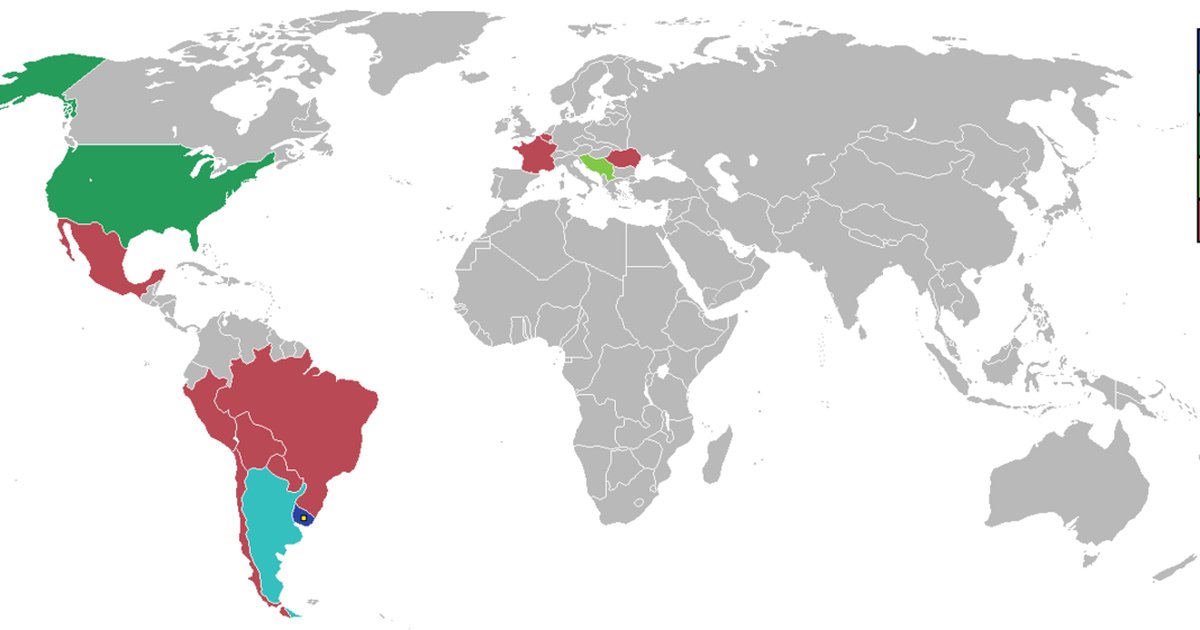
In July 1930, thirteen national teams gathered in Montevideo for an experiment nobody knew would work: the first FIFA World Cup. There were no qualifiers as we know them today, no television cameras, no sponsorship deals — just a brand-new tournament, a stadium built in a matter of months, and a host nation determined to prove it was the best football country on earth. By the end of the month, Uruguay had beaten Argentina 4–2 in the final, and football had the greatest competition in all of sport.
Nearly a century later, the 1930 World Cup still shapes everything about the tournament: the trophy, the format, and the idea that a single month of football can stop the world. This is the story of how it all began — the bold choice of host, the teams that crossed an ocean to be there, the final that made history, and the records that still stand.
Why Uruguay hosted the first World Cup
The idea of a world championship for national teams came from Jules Rimet, the president of FIFA, who believed football deserved its own global tournament, separate from the Olympic Games. By the late 1920s the plan was approved, and FIFA had to choose a host for the first edition in 1930.
Uruguay was the natural choice for two powerful reasons. First, the Uruguayans were the dominant force in world football: they had won the Olympic football tournaments in Paris in 1924 and Amsterdam in 1928, which at the time served as the world championships. Their dazzling short-passing team, built around José Leandro Andrade — known across Europe as "The Black Marvel" — had conquered the football world twice. Second, 1930 marked the centenary of Uruguay's first constitution, and the government wanted a celebration worthy of the occasion. A World Cup in Montevideo would put the small South American nation at the center of the sporting universe.
There was one condition that came with the honor: Uruguay promised to build a brand-new national stadium for the tournament. The result was the Estadio Centenario — named for the constitutional centenary — raised in roughly nine months in Montevideo's Parque Batlle. It was an enormous undertaking for the era, and it would become one of the most famous stadiums in football history.
Thirteen teams and a voyage across the Atlantic
Only thirteen teams took part in the first World Cup — a far cry from the expanded tournaments of the modern era. Seven came from South America: hosts Uruguay, Argentina, Brazil, Chile, Paraguay, Peru and Bolivia. Four made the long journey from Europe: France, Belgium, Yugoslavia and Romania. Two represented North America: the United States and Mexico.
The European participation was the tournament's great uncertainty. In 1930, crossing the Atlantic meant weeks aboard an ocean liner, not hours on a plane, and many European associations declined the invitation because of the cost and the time away from their domestic leagues. The four that accepted — France, Belgium, Yugoslavia and Romania — sailed for South America on long sea voyages, with the French squad famously traveling aboard the liner Conte Verde. Their commitment gave the first World Cup its claim to truly represent the world game.
There was no qualifying competition. Every team that accepted FIFA's invitation went straight to the finals in Montevideo, and the draw split the thirteen sides into four groups. It was a simpler, more improvised era of international football — and that improvisation is part of what makes 1930 so fascinating.
How the first World Cup worked
The format was straightforward: four groups, with the winner of each group advancing directly to the semifinals. Group 1 contained four teams — Argentina, Chile, France and Mexico — while the other three groups had three teams each. There was no round of 16, no quarterfinals and no second-place safety net: top the group or go home.
The group stage produced the tournament's first heroes. Argentina swept Group 1 with three wins, led by the goals of Guillermo Stábile. Yugoslavia surprised Brazil to win Group 2. Hosts Uruguay, roared on by enormous crowds, won Group 3. And the United States — a team few in Europe had heard of — won Group 4, defeating Belgium and Paraguay to reach the last four.
The semifinals were emphatic. Uruguay thrashed Yugoslavia 6–1 in front of a huge crowd at the Centenario, while Argentina beat the United States 6–1 in the other semifinal. The stage was set for the final everyone in South America wanted: the hosts against their great rivals, Uruguay versus Argentina, for the first world title.
The final: Uruguay 4–2 Argentina
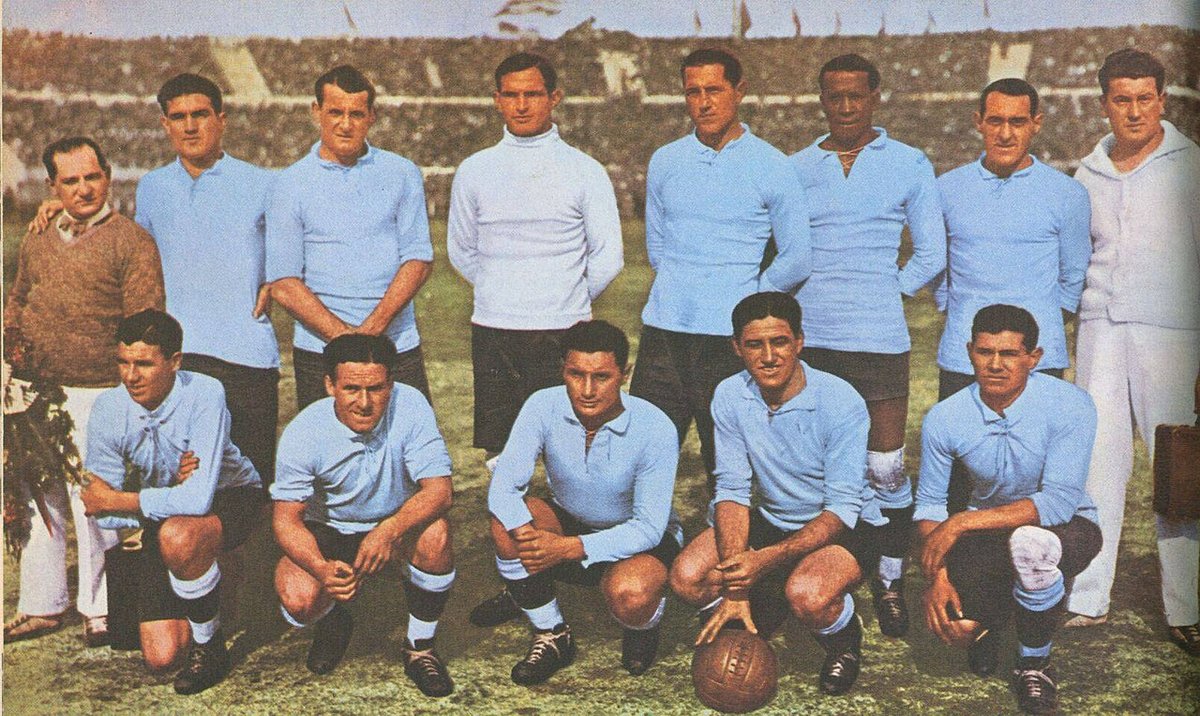
On July 30, 1930, the Estadio Centenario hosted the first World Cup final in history. Tens of thousands of supporters packed the new stadium — contemporary reports put the crowd at around 68,000, though estimates vary — creating an atmosphere that witnesses described as overwhelming. Uruguay against Argentina was already the fiercest rivalry in South American football; now it was for the world championship.
Uruguay struck first through Pablo Dorado, sending the home crowd into delirium. But Argentina, with the tournament's most feared attack, hit back before half-time: Carlos Peucelle equalized and Guillermo Stábile — who would finish as the tournament's top scorer — put the visitors 2–1 ahead. At the interval, the first World Cup looked like it was slipping away from the hosts.
What followed was one of the great second-half performances in football history. Pedro Cea, Uruguay's brilliant inside-forward, equalized to make it 2–2. Then Santos Iriarte smashed home to put Uruguay ahead, and with Argentina pushing desperately for an equalizer, Héctor Castro — the striker nicknamed "El Manco" who played with one hand after a childhood accident — sealed the 4–2 victory late on. The Centenario erupted. Uruguay were the first world champions, and captain José Nasazzi lifted the trophy that would later bear Jules Rimet's name.
The celebrations in Montevideo lasted for days. Uruguay had won the Olympics twice and now the World Cup: a tiny nation of under two million people stood alone at the summit of world football.
Estadio Centenario: the stadium built for history
The Estadio Centenario deserves its own chapter in the 1930 story. Built in about nine months specifically for the tournament, it was a race against time from the start — so much so that it was not completely finished when the World Cup kicked off, and some early matches had to be played at the smaller grounds of Peñarol and Nacional, the Estadio Pocitos and Parque Central.
But when it was ready, the Centenario was magnificent: a vast concrete bowl that could hold a huge crowd, and a fitting stage for a world final. Decades later, FIFA would declare it the first "Historical Monument of World Football," the only building in the world with that distinction. It remains the home of the Uruguay national team, and every World Cup final stadium since has followed in its footsteps.
Firsts and records of the 1930 World Cup
Because it was the first, almost everything that happened in Uruguay in July 1930 was a record — and several of them still stand out in football history.
The first World Cup goal: scored by France's Lucien Laurent in the opening match against Mexico on July 13, 1930. Laurent's volley, in a 4–1 French victory, was the goal that started it all.
The first hat-trick: scored by Bert Patenaude of the United States against Paraguay. For decades there was confusion over one of the goals, but FIFA officially confirmed Patenaude's treble in 2006.
The first Golden Boot: Argentina's Guillermo Stábile finished as the tournament's top scorer with 8 goals — a remarkable tally in an era of far fewer matches, and a record for a single World Cup that stood for decades.
The first champions: Uruguay, the only host nation to win the first World Cup they staged, completing a unique treble of the 1924 Olympics, the 1928 Olympics and the 1930 World Cup.
The third place: there was no third-place playoff in 1930. The United States, the surprise semifinalists, are recognized as finishing third ahead of Yugoslavia — still the best World Cup result by a team from outside South America and Europe.
The legacy of Uruguay 1930
The 1930 World Cup proved Jules Rimet's idea worked. Thirteen teams had been enough to create a genuine world championship, and the drama of the final — a comeback, a roaring home crowd, a trophy lifted by Nasazzi — gave the tournament a mythology from day one. The winners received a gold trophy that would later be named the Jules Rimet Trophy in honor of the man who made it happen.
The tournament established patterns that endure: the host nation dreaming of glory, the group stage giving way to sudden-death knockouts, and the final as the single most-watched sporting event on earth. Uruguay themselves would win it again twenty years later, in 1950, with the famous Maracanazo victory over Brazil in Rio de Janeiro — but nothing could ever match being first.
From thirteen teams and one new stadium in Montevideo grew the biggest sporting event in the world. Every World Cup since — from Brazil's five titles to Spain's triumphs — is a chapter in a story that began in Uruguay in July 1930.
Quick answers
Who won the first World Cup in 1930? Uruguay won the first FIFA World Cup in 1930, beating Argentina 4–2 in the final at the Estadio Centenario in Montevideo on July 30, 1930.
How many teams played in the 1930 World Cup? Thirteen teams took part: seven from South America, four from Europe and two from North America. There was no qualifying tournament — every invited team went straight to the finals.
Who scored the first goal in World Cup history? France's Lucien Laurent scored the first World Cup goal on July 13, 1930, in France's 4–1 win over Mexico.
Why was the Estadio Centenario built? Uruguay built the Estadio Centenario in about nine months specifically to host the 1930 World Cup, as part of the country's centenary celebrations. FIFA later declared it a Historical Monument of World Football.
Who was the top scorer of the 1930 World Cup? Argentina's Guillermo Stábile was the top scorer with 8 goals, despite Argentina losing the final to Uruguay.
Did Uruguay win any other World Cups? Yes. Uruguay won the World Cup again in 1950, beating hosts Brazil in the decisive match at the Maracaná in Rio de Janeiro — the famous Maracanazo.
Fútbol Libre is a guide to official viewing options.