
Premier League Results
By the Fútbol Libre editorial team · Last updated: November 8, 2026
Quick answer: Premier League results explained: today’s results, yesterday’s scores, how to read the table, form, and where to check every result.
Premier League results are the scores from the twenty clubs of the Premier League, the top division of English football. This guide explains how to find today’s Premier League results, yesterday’s Premier League results, and what each result means for the league table, the title race, the European places and the relegation battle.
The Premier League is played as 380 matches across 38 matchweeks, with each of the twenty clubs playing every other club once at home and once away. A win is worth three points, a draw is worth one point, and a loss is worth nothing. The results accumulate into the table, and the table decides almost everything: the champions, the clubs that qualify for Europe, and the three clubs that are relegated to the Championship.
This page carries no live scoreboard, so it cannot show you the score of a match that is still being played. What it does is explain how Premier League results work, how to read them properly, where the official results live, and how a single weekend of results can change the shape of the whole season. For the live scores as they happen, see our live football scores page and our football results today page.
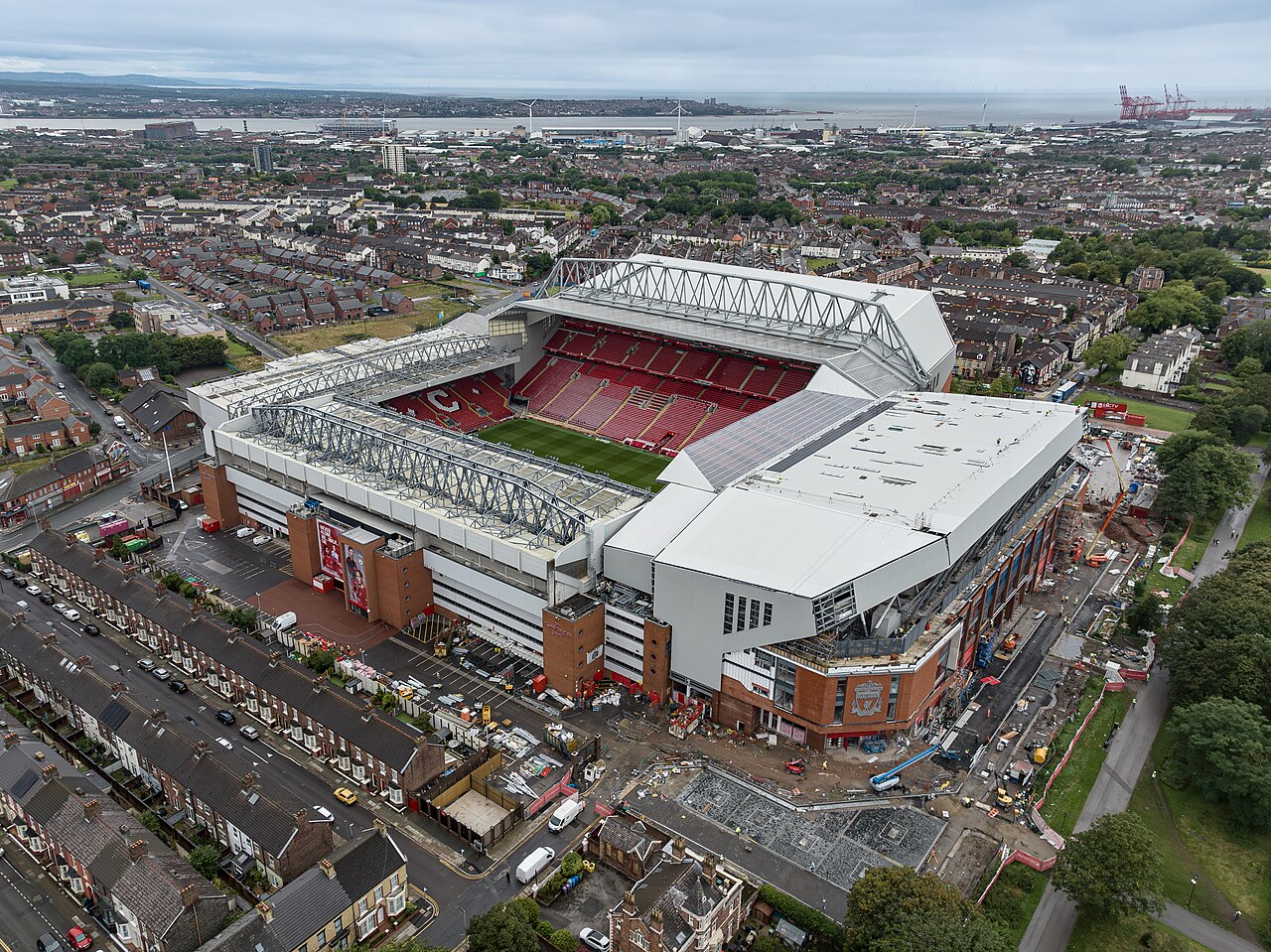
Photo: Arne Müseler, CC BY-SA 3.0 de, via Wikimedia Commons. Source: https://commons.wikimedia.org/wiki/File:Liverpool_anfield_road_stadium.jpg — Anfield, home of Liverpool — one of the twenty grounds where Premier League results are decided.
What "Premier League results" means
When someone searches for "premier league results", they usually want one of three things: the results from today, the results from the most recent matchweek, or the full list of results for the season so far. All three are the same competition seen at different scales, and all three are built from the same basic unit: a single match, two clubs, and a scoreline.
A Premier League result is normally written as the home club first, then the away club, then the score — for example, a 2-1 home win. The letters after a result tell you the status of the match: FT means full time, the match is finished and the score is final; HT means half time; and a result shown without a status is usually a scheduled fixture that has not started yet, not a result at all.
The most searched variations of the query tell the same story. "Premier league results today" is the biggest related search, because most fans check results on the day the matches are played. "Premier league results yesterday" is the next most common, for fans catching up the morning after. "Premier league results table" and "premier league results and table" show that many fans want the result and the table together, because a result only matters once you can see what it did to the standings.
Results also carry context that a bare scoreline hides. A 1-0 away win against a title rival matters more than a 1-0 home win against a club at the bottom of the table. A draw that keeps a club unbeaten is a good result for one side and a bad result for the other. Reading results well means reading them against the table, the form of the two clubs, and what was at stake in the match.
Premier League results today
Premier League matches are usually played across a weekend, from Friday evening to Monday evening, with midweek rounds at a few points in the season. The 2026-27 season runs from August 2026 to late May 2027, and by early November 2026 the season is around its tenth matchweek, with the table already taking shape but nothing decided.
On a matchday, results arrive in waves. The early kick-off finishes first, then the Saturday afternoon matches, then the evening match, and on Sundays the matches are staggered through the afternoon and evening. A results page checked at 5pm on a Saturday shows a very different picture from the same page checked at 10pm, because the later matches can change the order of the table.
The reliable way to follow today’s results is the official Premier League site and the major sports results services, which update within seconds of a goal or a final whistle. The BBC Sport football results pages are the most used free source in the UK, and they carry full-time scores, goalscorers and the updated table alongside each result. Our football results today page explains how to use those services across all competitions, not just the Premier League.
One warning applies to every results source: a score shown during a match is not a result. Live scores change, goals are disallowed after video review, and a match can be abandoned or postponed. A result is only final when the referee blows the full-time whistle, and the only scores worth quoting are the full-time ones.
Premier League results yesterday and the latest matchweek
Yesterday’s Premier League results are the results of the most recent completed matchday, and they are the fastest way to catch up on a season. The usual routine is simple: check the full-time scores, then check the table, then check the form of the clubs you follow. The table is the summary of every result so far, and a single matchweek can move a club several places in either direction.
Early in the season, one result can move a club five or six places, because the clubs are separated by only a point or two. Later in the season, the gaps widen, and a single result moves a club by one place at most. That is why the same 2-1 win feels very different in August, when the table is a jumble, and in April, when every point is fought over by clubs with almost nothing separating them.
The matchweek structure is part of the story. Each matchweek has ten matches, one for each of the twenty clubs, and a club’s result is always relative to the results of its rivals. A win that looks routine on its own can become a great result if the clubs above you all lost, and a draw that looks disappointing can become a good result if your direct rivals lost as well. That is why fans check the whole matchweek, not just their own club’s score.
Results from earlier in the season stay relevant all year. Head-to-head results between two clubs are never used to separate them in the Premier League table — goal difference comes first — but the results of the season so far are the whole basis of the table. A club’s position in May is the sum of every result since August, and the clubs that win the league are almost always the clubs that lose the fewest matches, not the clubs that win the most spectacular ones.
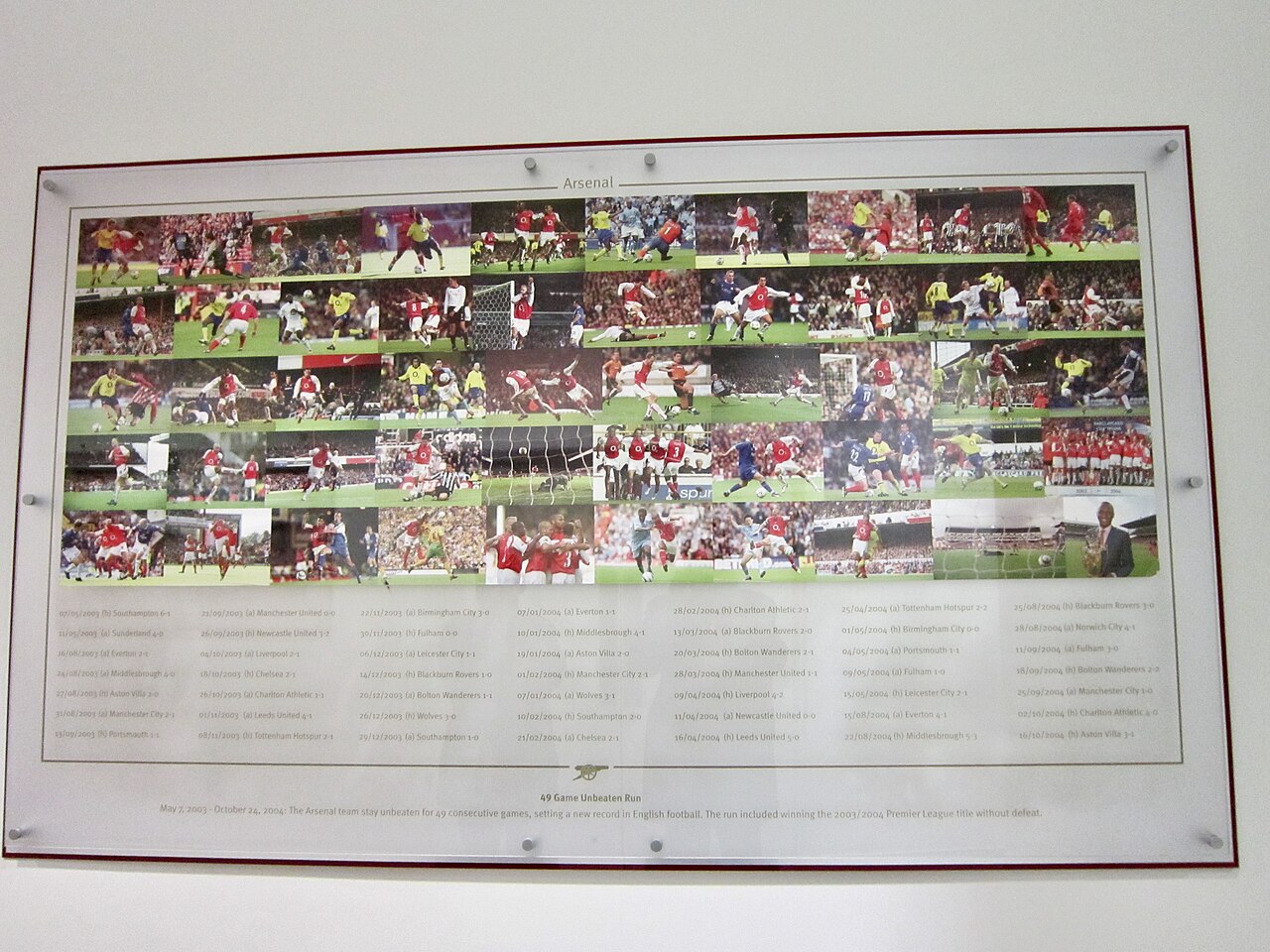
Photo: Ank kumar, CC BY-SA 4.0, via Wikimedia Commons. Source: https://commons.wikimedia.org/wiki/File:Arsenal_FC,_Emirates_stadium_01.jpg — Emirates Stadium, home of Arsenal — results here can move the top of the table in a single afternoon.
How Premier League results shape the table
The Premier League table is built entirely from results. Three points for a win, one for a draw, none for a loss, and the clubs are ranked by total points. When clubs are level on points, goal difference decides the order: goals scored minus goals conceded. If goal difference is also level, goals scored decides it. Only if two clubs are still level after all of that — identical points, goal difference and goals scored — does the league use a play-off match at a neutral ground to decide a championship, a European place or relegation, which has never been needed in the Premier League era.
Goal difference is why the size of a result matters, not just the outcome. A 4-0 win is worth the same three points as a 1-0 win, but it is worth four goals of goal difference, and that can decide a title or a relegation place at the end of the season. The most famous example is the 2011-12 title race, decided on goal difference on the final day, and every season since has had at least one place in the table decided by goal difference or goals scored.
The table is also read in zones, and each zone is decided by results. The top four qualify for the UEFA Champions League. Fifth place can also qualify for the Champions League depending on how English clubs perform in Europe that season, and the clubs below them qualify for the Europa League and the Conference League. The bottom three are relegated to the Championship. A result in August counts the same as a result in May, but a result in May is watched far more closely, because the zones are decided then.
Our Premier League table page explains the standings in full, including the European qualification places and how they change when a club wins a cup. Read the results and the table together: the results are the events, and the table is what the events add up to.
Reading form: the last five Premier League results
Form is the recent history of a club’s results, usually shown as the last five matches in the order they were played, written as W for a win, D for a draw and L for a loss. A club showing W-W-D-W-W has taken thirteen points from fifteen and is in strong form; a club showing L-L-D-L-L has taken one point and is in crisis. Form is not part of the official table, but it is the best short guide to where a club is heading.
Form matters because the Premier League is a long season and clubs go through runs. A club can be in the top four on the table and in poor form, which usually means it is about to drop, and a club can be near the bottom on the table and in good form, which usually means it is about to climb. Pundits and betting markets watch form closely for exactly this reason: the table tells you where a club has been, and form tells you where it is going.
Home and away form are worth separating. Some clubs are very strong at home and weak away, or the other way round, and a single form line hides that split. A club that has won its last five home matches but lost its last five away matches is a different prospect depending on where its next match is played. The best results pages show home and away form separately, and that split is worth checking before judging a result.
One caution: five matches is a small sample. A club can win three matches in a row by luck, or lose three by bad luck, and the form line will overstate both. Ten matches is a fairer guide, and the full season’s results are the fairest of all. Form is a signal, not a verdict, and it should always be read alongside the table and the difficulty of the matches a club has played.
Where to check Premier League results
The official results are published on the Premier League’s own site, premierleague.com, which carries every result, the goalscorers, the match statistics and the updated table. That is the source to trust when two results pages disagree. The BBC Sport football pages are the most used free alternative in the UK, and they carry results, reports and the table together, with highlights of every match on Match of the Day.
For watching the matches behind the results in the UK, the live rights in the 2026-27 season are split between Sky Sports, which shows at least 215 live matches a season, and TNT Sports, which shows 52, built around the Saturday 12.30pm kick-off. The BBC shows highlights of every match, free, on Match of the Day and BBC iPlayer. There is no free live Premier League coverage in the UK. In the United States, NBC and Peacock carry the Premier League. Our Premier League fixtures and how to watch in the UK guide and our where to watch the Premier League in the USA guide cover the broadcasters in full.
Two warnings apply to every results source. First, never trust a site that promises free live streams of Premier League matches: the official broadcasters above are the only legal way to watch, and the free stream sites are usually illegal, unsafe, or both. Second, check the date on any results page. A page that does not show when it was last updated may be showing last week’s results, and during a busy matchweek a stale page is worse than no page at all.
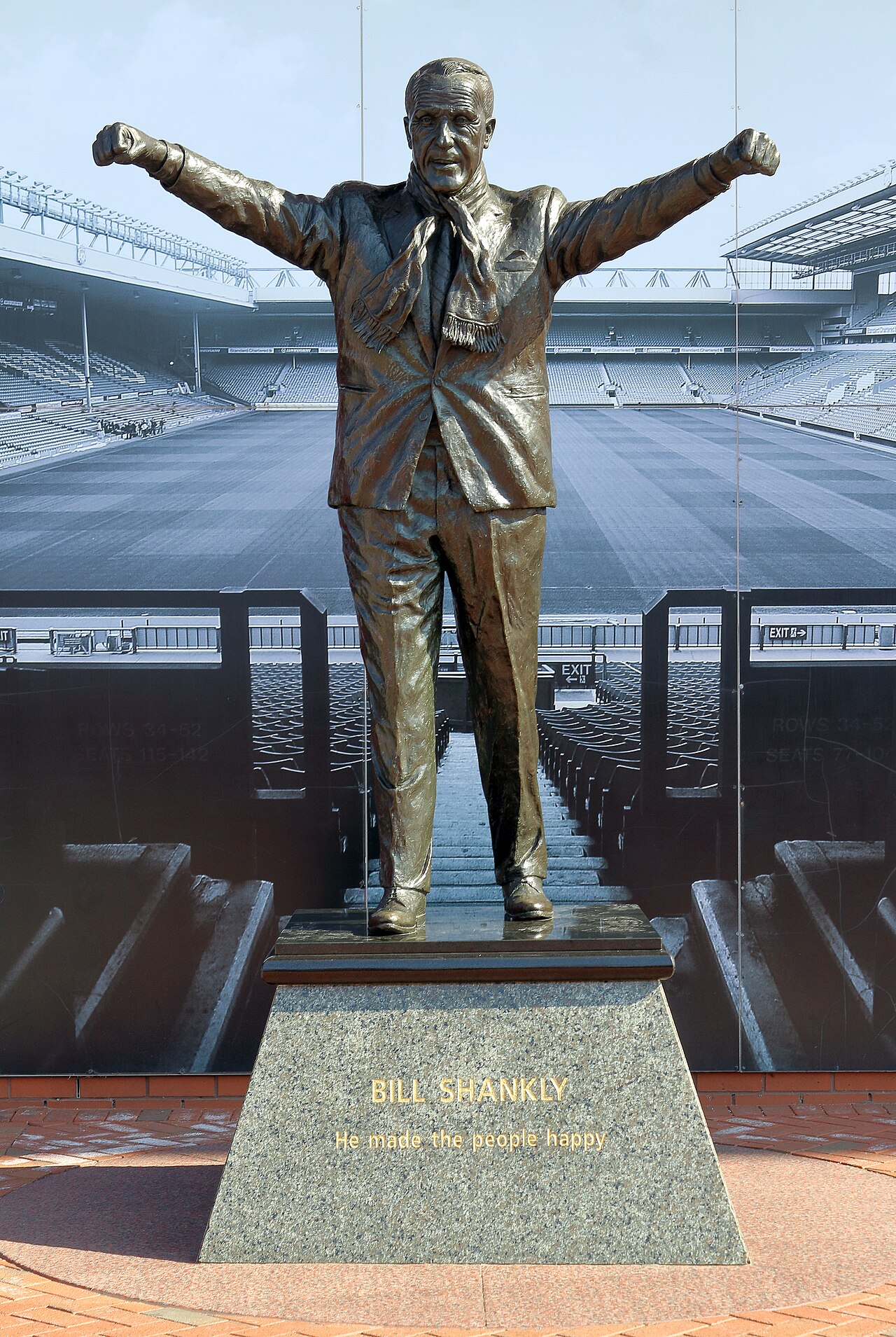
Photo: Rodhullandemu, CC BY-SA 4.0, via Wikimedia Commons. Source: https://commons.wikimedia.org/wiki/File:Bill_Shankly_statue,_Anfield_2018.jpg — The Bill Shankly statue at Anfield — a reminder that results build legacies, not just league positions.
Premier League results and the title race, Europe and relegation
Results matter differently depending on where a club sits in the table. At the top, the title race is decided by results against direct rivals: the six-point matches, where a win takes three points from a rival as well as adding three to your own total. A club that wins its matches against the other title contenders usually wins the league, even if it drops points elsewhere, because those are the results that decide the gap.
In the middle of the table, results decide European qualification, and the margins are thin. The difference between fifth and eighth is often a single win, and the clubs in that zone play each other late in the season in matches that decide who goes to Europe and who stays at home. Cup results matter here too: a club that wins the FA Cup or the Carabao Cup takes a European place, which can push the league qualification places down by one.
At the bottom, results decide relegation, and the maths is brutal. Three clubs go down, and the gap between seventeenth and eighteenth is often a single point on the final day. A draw that looks like a poor result in August can be the point that keeps a club up in May, and a win against a fellow struggler is worth double, because it takes points away from a direct rival. The relegation battle produces the most dramatic results of the season precisely because the stakes are survival.
Whatever zone your club is in, the discipline is the same: check the full-time result, check the table, check the form, and check the fixtures ahead. A result is never just a score. It is a change in the table, a change in the form line, and a change in what the next match means.
Common mistakes when reading Premier League results
The first mistake is quoting a live score as a result. A match that is 2-0 after an hour can finish 2-2, and a goal can be ruled out after a video review. Only full-time scores are results, and only full-time scores should be shared or used to judge a club.
The second mistake is reading the table without checking matches played. Early in the season, clubs can be two or three matches apart because of scheduling, and a club in tenth place with two games in hand may really be stronger than a club in sixth place that has played more matches. By the final day every club has played 38 matches, and the table needs no adjustment, but until then the games-played column is essential.
The third mistake is assuming goal difference is the first tiebreaker in every league. In the Premier League it is: points, then goal difference, then goals scored. That is different from some other leagues, where head-to-head results come first, and fans who apply the wrong rule get the order wrong.
The fourth mistake is judging a season by a single result. One defeat does not make a club bad, and one win does not make a club good. The Premier League is 38 matches long, and the table at the end of the season rewards consistency over a whole season, not brilliance on a single afternoon. The clubs that win the league are the ones that keep producing results, week after week, even when they play badly.
Premier League results FAQs
Where can I find Premier League results today?
On the official Premier League site, premierleague.com, and on the BBC Sport football results pages, which update within seconds of a goal or a final whistle. Our football results today page explains how to use those services across all competitions.
What time are Premier League results final?
A result is final when the referee blows the full-time whistle, usually around 90 minutes after kick-off plus stoppage time. Scores shown during a match are live scores, not results, and they can still change.
How are Premier League results decided when clubs tie on points?
By goal difference first, then goals scored. If two clubs are still level on points, goal difference and goals scored, the league uses a play-off match at a neutral ground to decide a championship, a European place or relegation — which has never been needed.
Do Premier League results decide who is relegated?
Yes. The three clubs at the bottom of the table after all 380 matches are relegated to the Championship, and the table is built entirely from the season’s results: three points for a win, one for a draw, none for a loss.
Where can I watch the Premier League in the UK?
Sky Sports shows at least 215 live matches a season and TNT Sports shows 52, built around the Saturday 12.30pm kick-off. The BBC shows highlights of every match free on Match of the Day and BBC iPlayer. There is no free live coverage in the UK.
What does FT mean in Premier League results?
FT means full time: the match is finished and the score is final. HT means half time, and a score shown without a status is usually a fixture that has not started yet, not a result.