
AFL Ladder
Quick answer: AFL ladder explained: how points, percentage and finals qualification work in Australian rules football — and where to check the official live ladder.
The AFL ladder is the table that Australian rules football lives by. From March to September, every conversation about the Australian Football League comes back to it: who is on top, who is clinging to the last finals place, and whose percentage is keeping them alive. If you have ever opened the ladder and wondered what the columns mean — why a team with fewer wins can sit above a team with more, or why percentage matters more than the score of any single game — this page explains it all. You will learn how the AFL ladder works, how points and percentage are calculated, how the ladder decides who plays finals, and what changed in 2026, when the finals expanded from the top eight to the top ten.
One thing first, stated plainly: this page shows no live ladder. A ladder that changes after every match cannot be honestly shown on a static page — a copied snapshot from last weekend would be wrong today. You will always find the current standings on the official AFL site: afl.com.au/ladder. What you get here is the knowledge to read that ladder properly — and to know exactly where to check it.
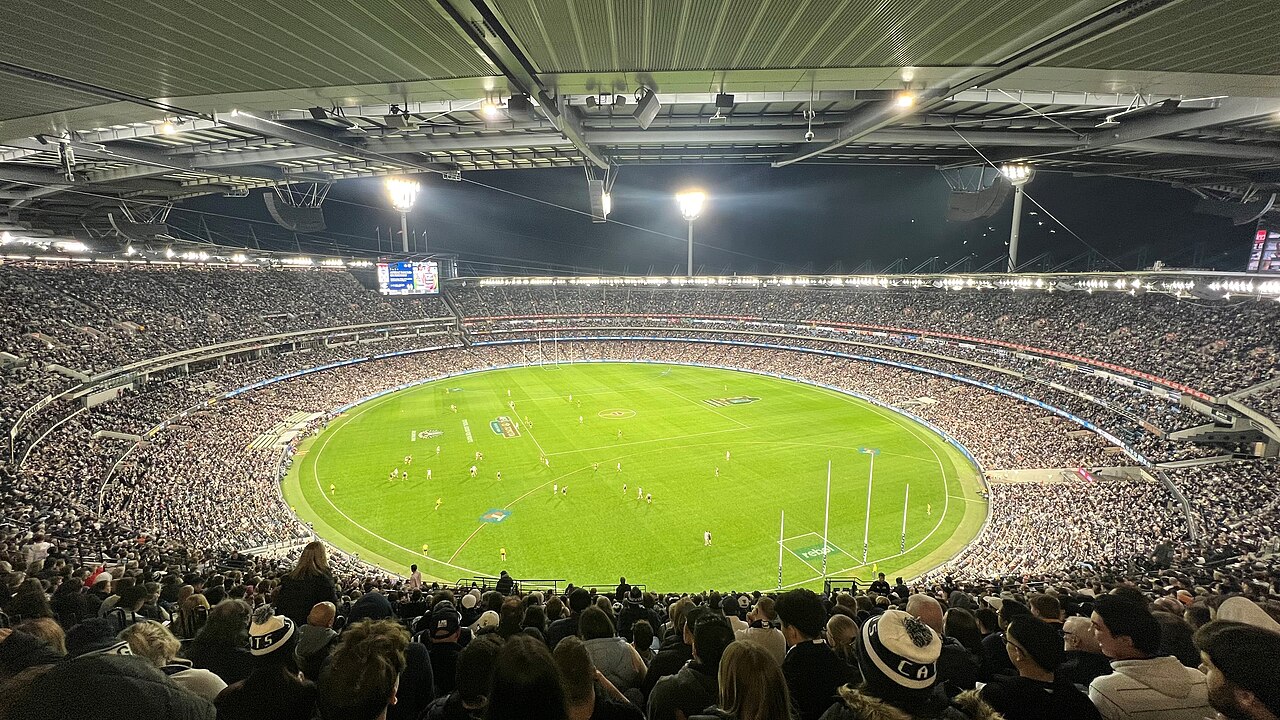
Photo: Storm machine, CC BY-SA 4.0, via Wikimedia Commons

How the AFL ladder works
The Australian Football League is the top professional competition in Australian rules football, a sport played on a large oval field with an oval ball, four posts at each end, and 18 players per team on the ground. The AFL ladder ranks the league's 18 clubs during the home-and-away season, the long regular season in which every club plays a set number of matches before the finals series begins. In 2026 each club plays 23 matches spread across 25 rounds, with byes built in so that not every club plays every week, for a total of 218 home-and-away matches. The 2026 season ran from 5 March to 26 September.
The ladder sorts clubs first by premiership points — the points earned from results — and then, when clubs are level on points, by percentage. If two clubs are still level after percentage is taken into account, the club that has scored more points across the season ranks higher. That is the whole system in one sentence, and everything else on this page is the detail behind it: how the points are earned, how percentage is worked out, and what the final ladder decides.
The ladder matters because it decides almost everything that follows. The club that finishes first wins the minor premiership. The clubs at the top qualify for the finals series, which ends in the Grand Final at the Melbourne Cricket Ground. The club that finishes 18th and last takes the wooden spoon, a title no club wants. There is no relegation in the AFL — the same 18 clubs return the following season — so the ladder is a race for position, not for survival.
What every column in the AFL ladder means
A row of the AFL ladder looks like a wall of abbreviations at first glance. In fact it is only a handful of figures, and they are quick to learn:
| Column | Meaning |
|---|---|
| Pos | Ladder position (1 to 18) |
| Club | Club name, often shortened — FRE, SYD, BRI, COL and the like |
| P | Played — matches played so far; vital when byes leave clubs on different numbers of games |
| W / L / D | Won, lost, drawn |
| For | Points scored by the club across the season (a goal is worth 6 points, a behind 1 point) |
| Against | Points conceded — scored against the club |
| % | Percentage: points for divided by points against, multiplied by 100 |
| Pts | Premiership points: wins × 4 plus draws × 2 |
Two columns deserve special attention. For and Against are not goals: they are the total match points a club has scored and conceded, built up goal by goal (six points) and behind by behind (one point) across every match. And percentage is the column that decides most of the close calls on the ladder, so it gets its own section below.
How AFL ladder points work
The points system is simple and has been unchanged for decades: a win is worth four premiership points, a draw two points for each team, and a defeat no points. A bye — a week off — earns no points at all. The system rewards winning above everything else: there is no bonus point for a big margin and no consolation point for a narrow loss, so a one-point win and a hundred-point win are worth exactly the same four points on the AFL ladder.
A worked example: a club with 15 wins, 1 draw and 7 defeats has 15 × 4 + 1 × 2 = 62 points. A club with 16 wins and 7 defeats has 16 × 4 = 64 points and sits above it, even though the first club lost fewer games — because in the AFL, as in most sports, only wins and draws put points on the board. Draws are rare in Australian rules football, because there is no extra time in the home-and-away season: if the scores are level at the final siren, the match is a draw and both clubs take two points.
How AFL percentage is calculated
Percentage is the AFL's great tiebreaker, and it is the number that confuses newcomers most. The formula is:
Percentage = (Points For ÷ Points Against) × 100
A percentage above 100 means a club has scored more points than it has conceded; below 100 means the opposite. A worked example from the AFL's own explainer shows how it works: a club that scored 2,194 points and conceded 1,647 has a percentage of 2,194 ÷ 1,647 × 100 = 133.2% — in other words, for every 100 points scored against it, the club scored just over 133 of its own.
Why does percentage matter so much? Because it is the first thing that separates clubs level on premiership points, and in an 18-team league with 23 matches each, clubs finish level on points constantly. Two clubs on 56 points are ordered by percentage alone, and a gap of a few percentage points can be the difference between a home final and a season over. Percentage also rewards attacking football in a way the points column does not: a club that wins narrowly every week and loses heavily when it loses can sit below a club with the same record but a healthier percentage, because its defeats cost it more in the For and Against columns. That is why coaches talk about percentage from round one, not just in the final weeks — a big loss in April can still be deciding a finals place in August.
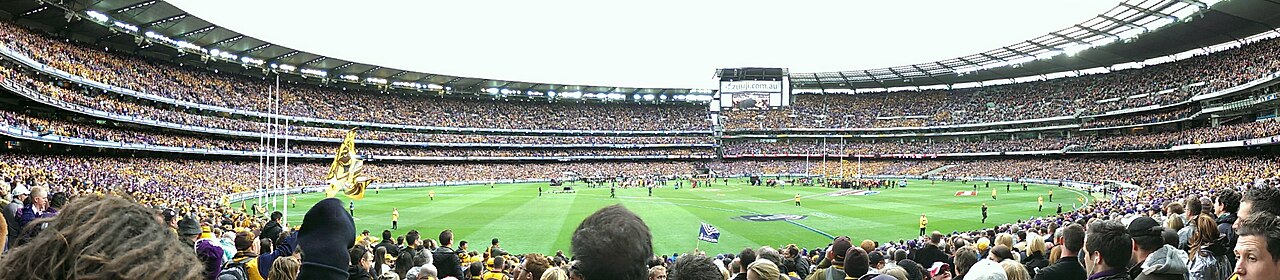
Photo: Steve Davidson, CC BY 2.0, via Wikimedia Commons

AFL ladder 2026: the season and the new finals format
The 2026 AFL season was a landmark year for the ladder, because the finals format changed for the first time in a generation. From 1994 to 2025, the top eight clubs after the home-and-away season qualified for the finals. From 2026, the top ten qualify, through a new wildcard round. The change means the ladder now has three zones that matter instead of two: the top six go straight into the traditional finals series, the clubs finishing seventh to tenth play sudden-death wildcard matches — seventh hosts tenth and eighth hosts ninth — and the two winners take the last two places in the final eight. The clubs finishing 11th to 18th see their season end.
The top four keep the advantage they have always had: the double chance. A club that finishes in the top four and loses its first final is not eliminated — it drops into a semi-final instead. Clubs that come through the wildcard round and the elimination finals have no such safety net: from their first final onward, every match is win or go home. That is why the difference between fourth and fifth on the AFL ladder is worth so much more than the difference between fifth and sixth, and why the race for the top four is the most intense battle of the home-and-away season.
The 2026 home-and-away season ran from 5 March to 26 September, with 218 matches across 25 rounds. Because of the byes, the P (played) column is uneven for much of the season — a club that has had its bye sits a game behind its rivals, and its position flatters or punishes it unfairly until the games even out. The only ladder that counts is the final one, after round 25, when every club has played 23 matches. Until then, points per game is the fairest way to compare clubs that have played different numbers of matches.
AFL finals: how the ladder decides who plays on
Once the home-and-away ladder is final, the finals series begins, and the ladder decides the shape of it. The top four play qualifying finals against each other; the winners earn a week off and go straight to the preliminary finals, while the losers face the winners of the elimination finals in the semi-finals. The winners of the semi-finals meet the winners of the qualifying finals in the preliminary finals, and the two preliminary-final winners meet in the Grand Final, traditionally played at the Melbourne Cricket Ground in front of around 100,000 people, to decide the premiers.
Finishing higher on the ladder buys real advantages beyond the double chance. The higher-ranked club hosts its final, which in Australian rules football — a game shaped by ground dimensions, travel and parochial crowds — is a genuine edge. A club that finishes first also earns the minor premiership, a recognised honour in its own right, even though the premiership itself is only decided by the Grand Final. And history shows how hard it is to win from outside the top four: since 1998, only one club has won the premiership after finishing outside the top four, which is why September is usually decided by the clubs that owned the ladder all year.
At the other end, the club that finishes 18th takes the wooden spoon. There is no relegation, so the spoon is a matter of pride and of draft position: the AFL's draft system gives the lowest clubs the earliest picks, which is how struggling clubs rebuild. A last-placed finish is therefore both a failure and, in the cold logic of list building, the start of the way back.
AFL ladder vs A-League: not the same ladder
This is the confusion that brings many people to this page, so it deserves a plain answer. The AFL ladder is the table of the Australian Football League, the professional competition for Australian rules football — the oval-ball, four-post, 18-a-side game played on cricket ovals like the MCG. The A-League is something else entirely: it is Australia's professional soccer league, played with a round ball on a rectangular pitch, with 11 players a side and a completely separate ladder, separate clubs and separate finals series. The two competitions share a country and a similar name, and search results mix them constantly — "a league", "a-league standings" and "a-league games" are soccer searches, not AFL searches — but they are different sports.
How to tell them apart in seconds: if the table talks about percentage, four points for a win, goals worth six and behinds worth one, it is the AFL ladder. If it talks about goal difference, three points for a win and 90-minute matches, it is a soccer table. If the clubs are called the Magpies, the Dockers and the Swans, it is the AFL; if they are called Sydney FC, Melbourne Victory and the Western Sydney Wanderers, it is the A-League. And if you came here looking for the soccer ladder, our football league standings guide explains how soccer tables work around the world.
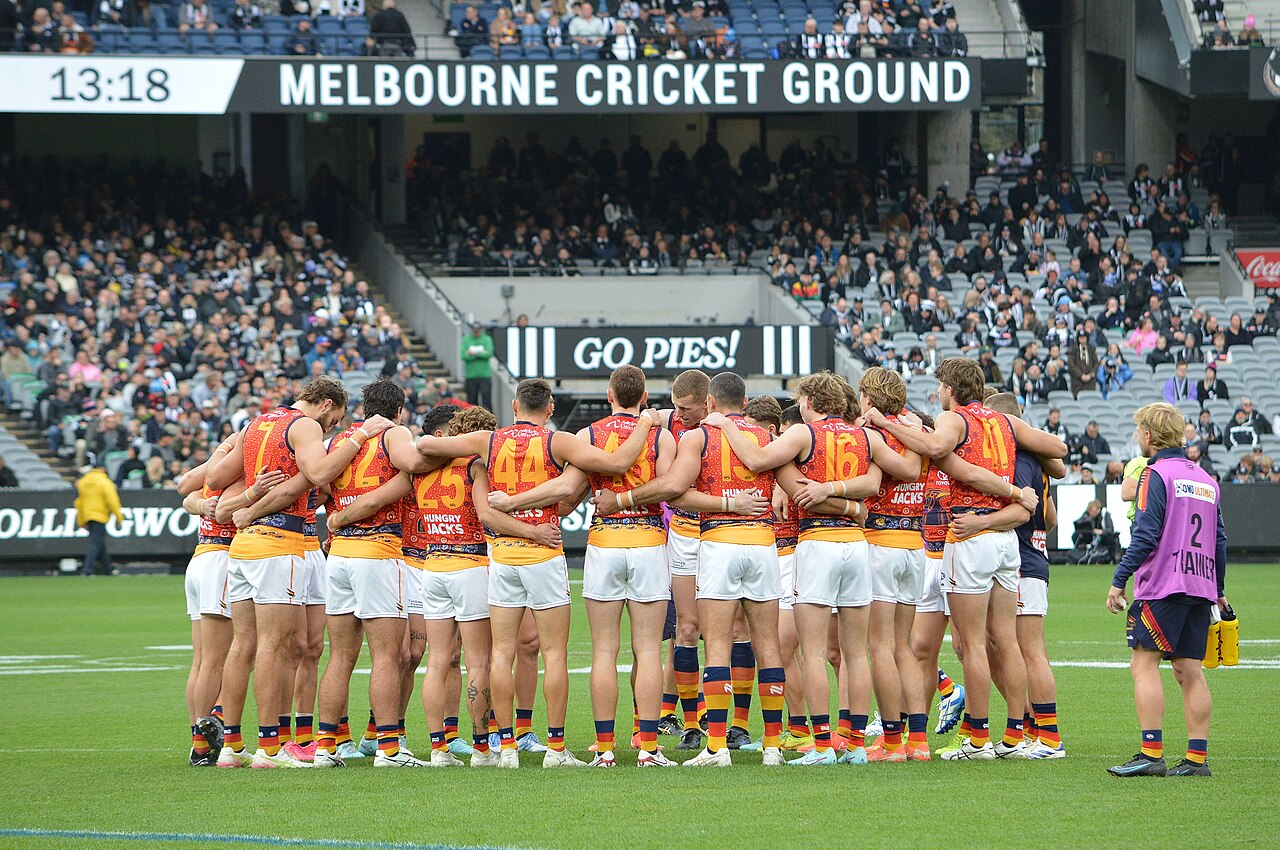
Photo: DustyNail, public domain (CC0), via Wikimedia Commons

The 18 AFL clubs on the ladder
Ten of the 18 clubs are based in Victoria, the heartland of the game, and the other eight come in pairs from the other states: two from Perth, two from Adelaide, two from Sydney and two from Queensland. The clubs, with their home grounds, are: Adelaide (Adelaide Oval), Brisbane Lions (the Gabba), Carlton (Marvel Stadium), Collingwood (MCG), Essendon (Marvel Stadium), Fremantle (Optus Stadium), Geelong (GMHBA Stadium), Gold Coast (People First Stadium), Greater Western Sydney (ENGIE Stadium), Hawthorn (MCG and Launceston), Melbourne (MCG), North Melbourne (Marvel Stadium), Port Adelaide (Adelaide Oval), Richmond (MCG), St Kilda (Marvel Stadium), Sydney (SCG), West Coast (Optus Stadium) and the Western Bulldogs (Marvel Stadium). Most Melbourne clubs share the MCG and Marvel Stadium, which is why the ladder's Melbourne derbies feel like home games for both sides.
A 19th club, Tasmania, is scheduled to join the competition in 2028, which will take the ladder to 19 clubs and change the fixture for the first time since the Gold Coast and Greater Western Sydney joined in 2011 and 2012. Until then, the ladder stays at 18 — and the arithmetic of the season stays at 23 matches per club.
A short history of the AFL ladder
The competition began as the Victorian Football League in 1897, with eight clubs, and took its current name — the Australian Football League — in 1990, as the game expanded beyond Victoria. The ladder grew with the league: from eight clubs to ten, then twelve, then sixteen, and finally to the current 18. The scoring system has barely changed in all that time: six points for a goal, one for a behind, four premiership points for a win. Carlton, Collingwood and Essendon share the record of 16 premierships apiece, a reminder of how long the Victorian clubs have dominated the game.
The Grand Final has been played at the Melbourne Cricket Ground almost every year since the competition began, and the MCG is woven into the ladder's story: finishing on top earns the right to play finals at the game's biggest ground, and the Grand Final's capacity crowd of around 100,000 makes it the largest annual sporting event in Australia. The ladder is not just a table; it is the road to the last Saturday in September.
Common mistakes when reading the AFL ladder
Four mistakes come up again and again. First: judging the ladder before the byes even out. A club sitting first in round 10 may simply have played one game more than its rivals — check the P column before celebrating or panicking. Second: ignoring percentage. Two clubs on the same points are ordered by percentage, and a club with a percentage of 130 is in a far stronger position than a club on the same points with a percentage of 95, because percentage measures the quality of every win and every loss, not just the count.
Third: assuming the old top-eight finals system still applies. From 2026, tenth place is a finals place — a club that would have missed September under the old system now gets a wildcard match, and a club in seventh can no longer assume it is safe. Fourth: confusing the AFL ladder with a soccer table. Three points for a win, goal difference and 90 minutes mean soccer; four points for a win, percentage and four quarters mean Australian rules football. Check the sport before you trust the table.
Where to check the live AFL ladder
The most reliable source for the current ladder is the official one: afl.com.au/ladder is updated after every match, and it shows the ladder together with form, fixtures and results. The AFL's own app and the clubs' official sites carry the same table. On Fútbol Libre, keep the ladder next to the rest of the picture: our football league standings guide explains how soccer tables work, today's fixtures show who plays and when, and live scores and results show how each round reshapes every table we cover.
Official ladder: always check the current standings on the official AFL site — afl.com.au/ladder. No streams are hosted on this site.
Frequently asked questions
Where can I find the official AFL ladder?
On the AFL's own site at afl.com.au/ladder. It is updated after every match and shows position, premiership points, percentage and fixtures together. This page explains how to read the ladder but deliberately shows no copied live ladder, which would be out of date after the next match.
How many points do you get for a win on the AFL ladder?
Four points for a win, two points each for a draw, and no points for a defeat. A bye earns no points. The system has been in place for decades, and the club with the most points after 23 matches finishes on top of the ladder.
How is AFL percentage calculated?
Percentage is points scored divided by points conceded, multiplied by 100. A percentage above 100 means a club has scored more than it has conceded. It is the first tiebreaker when two clubs finish level on premiership points, ahead of total points scored.
How many teams make the AFL finals in 2026?
Ten. From 2026 the finals expanded from the top eight to the top ten, with a new wildcard round: seventh hosts tenth and eighth hosts ninth, and the two winners join the traditional final eight. The top four keep the double chance.
What is the wooden spoon in the AFL?
It is the unwanted title given to the club that finishes 18th and last on the ladder at the end of the home-and-away season. There is no relegation in the AFL, so the spoon is a matter of pride — and of draft position, since the lowest clubs get the earliest draft picks.
What is the difference between the AFL ladder and the A-League ladder?
They are different sports. The AFL ladder is the table of Australian rules football — oval ball, four posts, four points for a win, percentage as the tiebreaker. The A-League is Australia's professional soccer league — round ball, three points for a win, goal difference as the tiebreaker. The two competitions share a country, not a sport.
What is the minor premiership?
It is the honour given to the club that finishes first on the ladder after the home-and-away season. It is a recognised title in its own right, but it is not the premiership itself — that is decided by the Grand Final, played at the Melbourne Cricket Ground.