
4-3-3 Formation Explained: The Secret Behind Modern Football
By Redacción Futbollibre · Published October 21, 2026
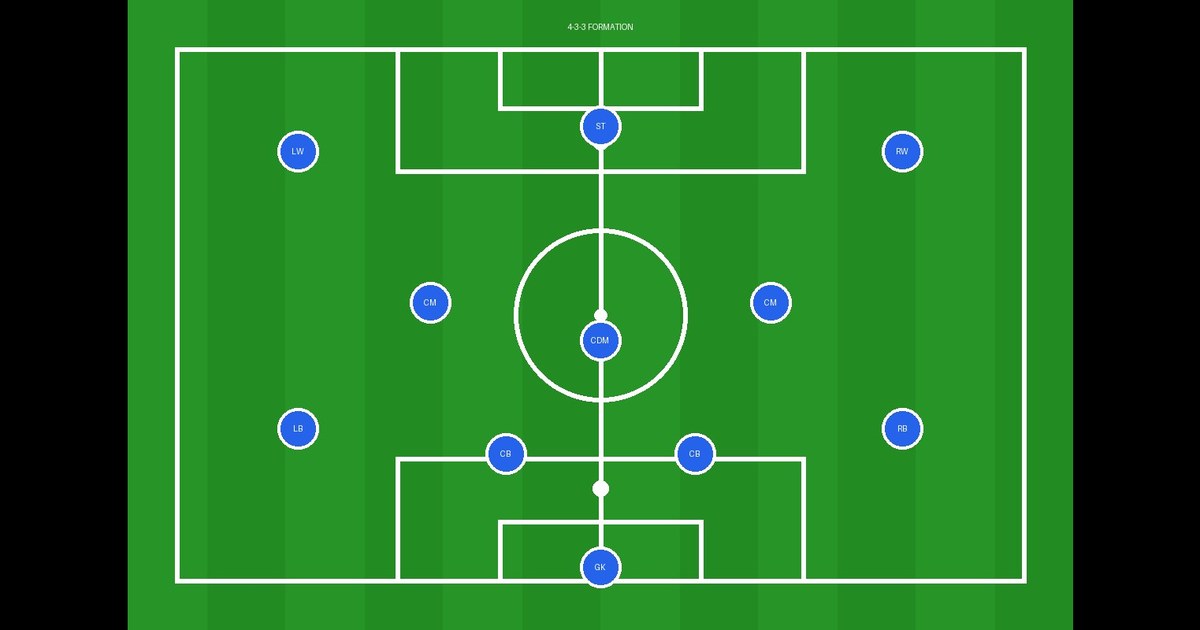
No formation has shaped modern football like the 4-3-3. Four defenders, three midfielders, three forwards — a shape so balanced, so flexible, and so dominant that it became the default system of the sport's greatest teams: the Ajax of Johan Cruyff, the Barcelona of Pep Guardiola, and the Spain side that conquered the world between 2008 and 2012. If you want to understand how elite football is actually played, start here.
This guide breaks down the 4-3-3 completely: the shape itself, what each line is asked to do, the key variants like the false nine, the strengths that made it dominant, the weaknesses opponents target, and the teams that turned it into history. Whether you play, coach, or just watch, the 4-3-3 is the formation worth knowing best.
The shape: simple, balanced, everywhere
The 4-3-3 is exactly what the numbers say: one goalkeeper, a back four (two center-backs and two fullbacks), a midfield three, and a front three (two wingers and a central striker). Its genius is geometric. The shape creates natural triangles all over the pitch — the foundation of the passing game — and it divides the field into clear zones of responsibility: defense, control, and attack.
What made the 4-3-3 conquer football is its adaptability. The same eleven players can defend in a compact 4-5-1, build up through midfield overloads, and attack with five or six players flooding forward — all without changing shape. It is a system that stretches the pitch wide in attack and compresses it in defense, and that dual personality is why coaches at every level, from youth academies to World Cup finals, keep coming back to it.
It also scales beautifully. A children's team can play a simple 4-3-3 focused on shape and spacing, while an elite side plays the same numbers with intricate rotations and pressing traps. Few formations work as well for beginners learning positions as they do for professionals executing complex game plans — and that universality is a quiet reason the 4-3-3 became football's lingua franca.
The back four: foundation of everything
Every 4-3-3 starts at the back. The two center-backs are the defensive core: winning headers, making tackles, and organizing the line. In the modern game they are also the first playmakers — the best 4-3-3 teams build attacks from the center-backs, who must be calm on the ball and able to pass through the lines rather than just clearing it long.
The fullbacks are where the 4-3-3 shows its attacking ambition. In possession they push high and wide, effectively becoming wingers, which stretches the opponent's defense and creates the overloads the system thrives on. Defensively they must have the stamina to sprint back just as fast. The modern attacking fullback — bombing forward to cross, then recovering sixty yards — is a product of 4-3-3 thinking, and the position demands arguably the greatest engine on the pitch.
Behind them, the goalkeeper in a 4-3-3 is rarely just a shot-stopper. Because the defensive line plays high to compress space, the keeper must sweep behind it, rushing out to clear through balls, and must be comfortable receiving backpasses under pressure to help the team play out from the back. The sweeper-keeper and the 4-3-3 grew up together.
The midfield three: the engine room
The midfield three is the heart of the 4-3-3 — the zone where matches are won and lost. Its classic arrangement is a triangle: one deep midfielder shielding the defense, and two advanced midfielders ahead of them.
The deep-lying midfielder — the number six, the pivot — is the system's brain. Positioned in front of the center-backs, this player receives the ball under pressure, dictates the tempo, and covers the space behind the attacking midfielders. The great pivots read the game two passes ahead: intercepting danger before it forms and starting attacks with one clever pass. It is the most tactically demanding position in the formation.
The two advanced midfielders — often called number eights — are box-to-box engines. They press high, arrive late in the penalty area, link midfield to attack, and track back to protect the pivot. The best eights combine the stamina of a defensive midfielder with the creativity of a playmaker, and their late runs into the box are one of the 4-3-3's deadliest weapons because opponents struggle to track runners arriving from deep.
The triangle can flip. Some teams play with two deep midfielders and one advanced playmaker — a double pivot — which trades some attacking thrust for defensive solidity and is harder to play through centrally. The choice between a single pivot and a double pivot is one of the defining tactical decisions of a 4-3-3 coach.
The front three: width, pace, and goals
The front three is the 4-3-3's attacking identity. The two wingers stay wide to stretch the defense, then attack: dribbling at fullbacks, cutting inside to shoot, or crossing for the striker. Modern wingers are often inverted — right-footers on the left wing and vice versa — so they can cut inside onto their strong foot and shoot, a trend the 4-3-3 perfected.
The central striker — the number nine — leads the line: holding up the ball, making runs behind the defense, and finishing chances. But the striker's job in a 4-3-3 goes beyond goals. They are the first defender, pressing the opponent's center-backs, and their movement creates the space the wingers and midfielders exploit. A static striker strangles a 4-3-3; a mobile one makes it sing.
The interplay between the lines is what makes the front three lethal. Wingers drag fullbacks wide, opening channels for the eights' late runs; the striker drops deep, pulling a center-back out and leaving space behind; the fullbacks overlap, creating two-on-ones out wide. It is choreographed chaos, and when it clicks, defenses cannot cover everything at once.
Key variants: the false nine and the double pivot
The 4-3-3's greatness lies in its variants — same shape, radically different behavior. The most famous is the false nine. Instead of a traditional striker leading the line, a creative player drops deep from the number nine position into midfield, dragging the opposing center-backs with them into confusion: follow the false nine and leave space behind, or hold position and let them turn freely? The false nine creates a midfield overload and chaos in equal measure, and it demands wingers who attack the space the false nine vacates.
The double pivot variant, as described above, stations two midfielders deep instead of one. It is the pragmatic 4-3-3: harder to counterattack against, stronger in central midfield battles, but with one fewer body joining the attack. Coaches reach for it against superior opponents or to protect a lead — proof that the 4-3-3 can be a defensive system too.
Other wrinkles include the asymmetric 4-3-3, where one fullback bombs forward while the other tucks in to form a back three in possession, and the narrow 4-3-3, where the wingers drift inside to overload central areas. The shape stays; the interpretation changes everything.
Strengths: why it dominates
The 4-3-3's first strength is natural width. With true wingers and attacking fullbacks, it stretches opponents horizontally, creating the gaps that clever players exploit. Its second is the midfield triangle, which almost always creates a numerical advantage in the center — three against two in most matchups — letting the team control possession and tempo.
Third, it attacks in numbers without sacrificing defensive shape. Five or six players can join an attack while the pivot and back four hold the fort. Fourth, it presses brilliantly: the front three can hunt the ball high up the pitch with midfield support close behind, which is why the great pressing teams of the modern era so often play 4-3-3. It is, in short, a formation with no obvious structural hole — which is precisely why beating it requires such careful planning.
There is a subtler strength too: player development. Because the 4-3-3 gives every player clear but demanding responsibilities — fullbacks who attack and defend, midfielders who do both phases, wingers who track back — it teaches complete footballers rather than specialists. That is a major reason the world's best academies teach the 4-3-3 to young players: even if a senior team later switches systems, the habits learned in a 4-3-3 transfer everywhere. A youth player raised in this shape understands width, compactness, and transitions as instincts, not instructions.
Weaknesses: where opponents attack it
No formation is perfect. The 4-3-3's great vulnerability is the space behind the attacking fullbacks. When both fullbacks push high, the flanks behind them are exposed, and quick wingers or long diagonal passes can exploit the gap before the fullbacks recover. Opponents deliberately target this with fast counterattacks down the wings.
The lone pivot can be isolated. Against a midfield three of their own — or a double pivot — opponents can outnumber the single defensive midfielder, cutting off the supply line between defense and attack. If the pivot is bypassed, the center-backs are suddenly exposed with no shield.
Finally, the 4-3-3 can become predictable and stretched. If the wingers stay too wide and the striker too isolated, the team attacks in disconnected units with a huge gap between midfield and attack. And a 4-3-3 that loses the midfield battle often loses the match, because the whole system depends on controlling the center. The formation rewards technical, intelligent players — and punishes teams that lack them.
The teams that made it legendary
Three teams define the 4-3-3's mythology. First, Ajax under Johan Cruyff and Rinus Michels in the 1970s, the cradle of Total Football — players interchanging positions within a fluid 4-3-3 framework, dominating Dutch and European football and establishing the philosophical roots the formation still carries: technique, intelligence, and positional fluidity.
Second, Barcelona under Pep Guardiola, who took Cruyff's ideas and refined them into arguably the greatest club side ever seen. The 4-3-3 with a false nine, the midfield triangle controlling every match, the high press winning the ball back in seconds — Guardiola's Barcelona was the formation's perfect expression, and its influence spread to every corner of world football.
Third, Spain's national team from 2008 to 2012, winners of two European Championships and a World Cup playing a 4-3-3 built on overwhelming midfield control. Spain proved the system could conquer international football too, strangling opponents with possession and striking through the tiniest gaps. When people call the 4-3-3 football's most dominant system, these three teams are the evidence.
Fútbol Libre is a guide to official viewing options.
Quick answers
What is the 4-3-3 formation? A football formation with four defenders, three midfielders and three forwards (two wingers and a central striker), prized for its balance between defense, midfield control and attack.
What are the player roles in a 4-3-3? Two center-backs and two attacking fullbacks defend; a deep-lying pivot plus two box-to-box midfielders control the center; two wingers provide width and a central striker leads the line.
What is a false nine in a 4-3-3? A variant where the central striker drops deep into midfield instead of leading the line, dragging center-backs out of position and creating overloads — famously used to devastating effect by Guardiola's Barcelona.
What are the strengths of the 4-3-3? Natural width, a midfield triangle that usually creates numerical superiority in the center, the ability to attack in numbers while keeping defensive shape, and an ideal structure for high pressing.
What are the weaknesses of the 4-3-3? Space behind the attacking fullbacks on counterattacks, the risk of isolating a lone defensive midfielder against packed midfields, and a tendency to become stretched and predictable if the lines disconnect.
Which famous teams used the 4-3-3? Cruyff's Ajax of the 1970s pioneered its Total Football expression, Guardiola's Barcelona perfected it with the false nine, and Spain's 2008–2012 side used it to win two European Championships and a World Cup.
Sources
The history in this guide is checked against official club and FIFA sources:
- Manchester City — From Cruyff to Pep: Guardiola's turning point — how Cruyff's Total Football at Ajax and Barcelona, built on the 4-3-3, shaped Guardiola.
- FIFA — Spain's 2010 conquerors in numbers — Spain's tiki-taka side, the 4-3-3's most famous national-team expression, and their first World Cup title.