
Women's World Cup 2027 Brazil: Dates, Teams, Cities Guide
By the Fútbol Libre editorial team · Last updated: October 31, 2026
First, the clarification that matters most: there is no men's FIFA World Cup in 2027. The men's tournament is quadrennial — after the men's 2026 edition, the next men's World Cup is 2030, hosted mainly by Morocco, Portugal and Spain, with centenary matches in Uruguay, Argentina and Paraguay. The tournament called "World Cup 2027" is the FIFA Women's World Cup Brazil 2027, and this guide covers that tournament only. Nothing here reuses men's 2026 fixtures or "next World Cup" framing. Facts below were last verified on October 30, 2026; fixtures are not yet known because the final draw has not taken place, so no individual match, opponent or kick-off time is published here.
The 2027 Women's World Cup is the tenth edition of the tournament and the first Women's World Cup ever held in South America.It takes place in Brazil from June 24 to July 25, 2027, with 32 teams playing 64 matches across eight host cities.Brazil, the host nation, plays the opening match at the Maracanã in Rio de Janeiro on June 24, and the same stadium hosts the final on July 25.Spain arrives as defending champions, having won their first world title in 2023.
For a Spanish-speaking audience, the key point is simple: this is the biggest women's football tournament ever staged in the continent, and it is a full month of football — not a single weekend of finals.
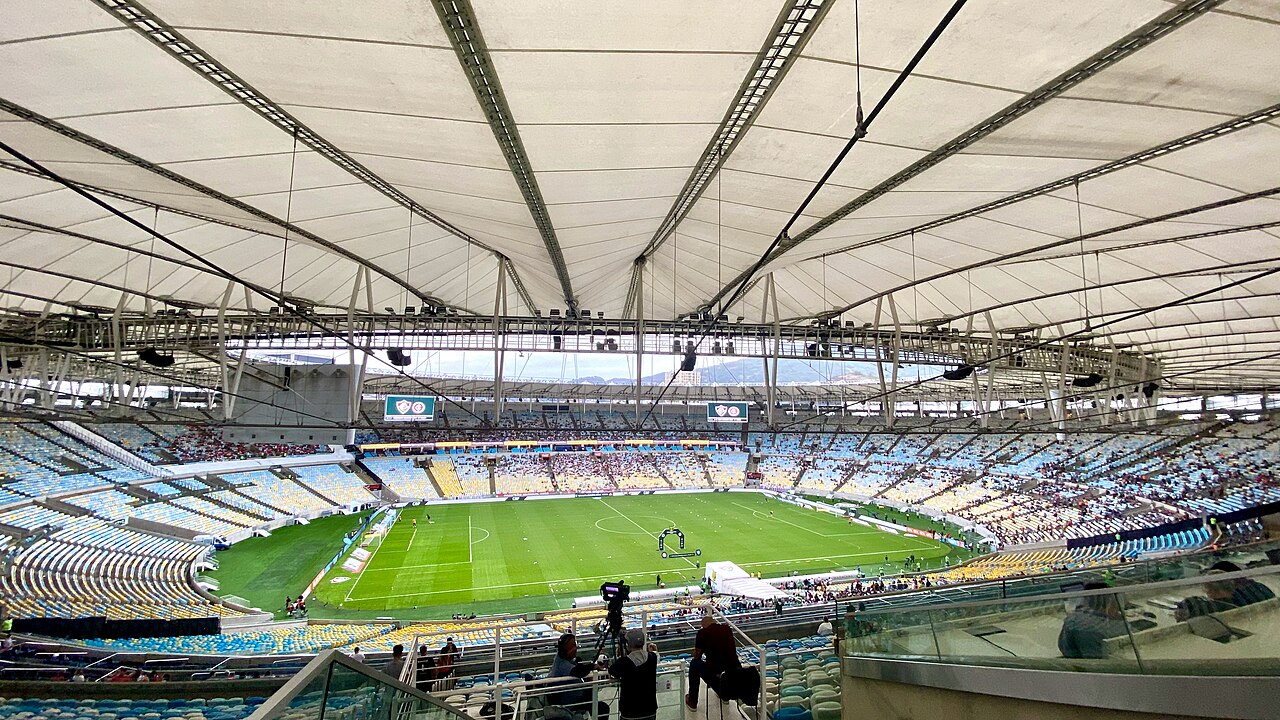
Photo: Thaismay, CC BY-SA 4.0, via Wikimedia Commons. The Maracanã hosts the opening match on June 24 and the final on July 25, 2027.
When and where is the Women's World Cup 2027?
Brazil was selected as host on May 17, 2024, at the FIFA Congress in Bangkok.The tournament runs from June 24 to July 25, 2027 — a little over four weeks.That length matters for planning: the group stage alone covers more than two weeks, and the knockout rounds then compress into the final fortnight.Every host city stages at least six group matches plus at least one knockout tie, so the tournament is genuinely spread across the country rather than concentrated in Rio and São Paulo.FIFA's own schedule announcement confirms the opening and final venues, the 32-team field and the 64-match total.The round-by-round calendar — group stage, round of 16, quarter-finals, semi-finals, third-place match and final — is reported by secondary schedule summaries as June 24 to July 8 for the groups, July 10 to 13 for the round of 16, July 16 to 17 for the quarter-finals, July 20 to 21 for the semi-finals, July 24 for the third-place match in São Paulo and July 25 for the final.
Those round dates are labelled here as reported, because they were not confirmed on a FIFA page opened during the research for this guide; they will be re-checked against FIFA's official match schedule before any fixture-level page is published.What is confirmed is the framework: dates, host, teams, format and cities.
How the tournament works
The format is the same one used at Australia and New Zealand 2023, the first 32-team edition.Eight groups of four teams play a round-robin, and the top two from each group advance to the round of 16.From there it is straight knockout: round of 16, quarter-finals, semi-finals, a third-place play-off and the final.In total that is 48 group matches and 16 knockout matches, making 64.The slot allocation, decided by the FIFA Council on December 10, 2024, is: AFC 6, CAF 4, Concacaf 4, CONMEBOL 3 including hosts Brazil, OFC 1, UEFA 11, and 3 places from the inter-confederation play-off tournament.That adds up to 32.The practical consequence for fans is that the group stage is where most of the football lives — 48 of the 64 matches — and that a team needs only to finish in the top two of its group to reach the knockouts, which keeps groups alive into the third matchday.
No team is eliminated on a single bad result in the group stage, and no group winner gets an easy path by design: the bracket pairs group winners with runners-up from other groups.
Host cities and stadiums
Eight cities host matches, announced on May 7, 2025.Rio de Janeiro's Maracanã is the centrepiece — opening match and final — and São Paulo's Arena Corinthians, also called Neo Química Arena or Arena Itaquera, hosts the most matches, ten.The other six are Brasília (Estádio Nacional Mané Garrincha), Belo Horizonte (Estádio Mineirão), Fortaleza (Arena Castelão), Porto Alegre (Estádio Beira-Rio), Salvador (Arena Fonte Nova) and Recife (Arena de Pernambuco).For travelling fans, the spread is the story: the tournament touches the south (Porto Alegre), the south-east (Rio, São Paulo, Belo Horizonte), the centre-west (Brasília) and the north-east (Fortaleza, Salvador, Recife).
Each city hosts at least one knockout tie, so a fan based in any host city will see more than group football.The Maracanã, with a capacity of around 78,800, is the only stadium that hosts both the first and the last match of the tournament.
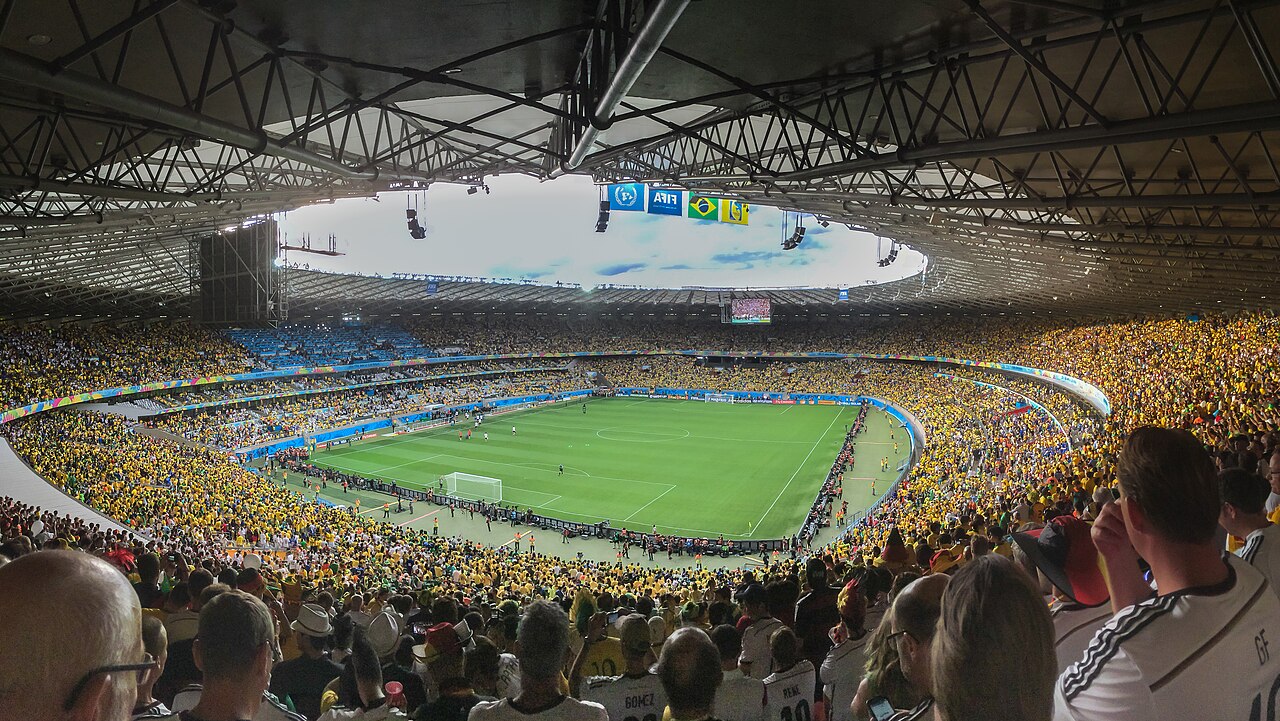
Photo: dronepicr, CC BY 2.0, via Wikimedia Commons. The Mineirão in Belo Horizonte is one of the eight host stadiums.
Who has qualified so far?
As of the latest qualified-team snapshot found in this research, dated October 10, 2026, 18 of the 32 places were confirmed and 14 were still to be decided.The confirmed teams were: hosts Brazil; from Asia, Australia, China PR, Japan, Korea DPR, Korea Republic and the Philippines; from Africa, Algeria, Cameroon, Malawi and Morocco; from South America, Argentina and Colombia, plus hosts Brazil; from Oceania, New Zealand; and from Europe, Denmark, France, Germany and Spain.Two facts in that list matter most to this site's readers.First, Argentina is already qualified, through a direct South American place.Second, Spain is already qualified, as a UEFA group winner, and arrives as defending champions.The remaining 14 places are decided in three blocks: seven UEFA places through the play-off second round from November 26 to December 5, 2026; four Concacaf places through the Concacaf W Championship in November and December 2026; and three places through the inter-confederation play-off tournament, whose preliminary phase is in November and December 2026 and whose final phase is in February 2027.
That means this list will move after October 2026, and any page that repeats it should be re-verified after those windows close.
What is still to be decided?
Three things are still open, and this guide does not pretend otherwise.First, the final draw: FIFA has confirmed it for Friday, December 11, 2026, at the Museum of Modern Art in Rio de Janeiro, in its ticket-sales announcement of November 13, 2026.It should not be confused with the separate preliminary-phase draw for the play-off tournament.Second, the individual fixtures: groups, opponents and kick-off times cannot be known until the final draw, and none are published here.Third, the last 14 qualifiers, decided in the windows listed above.The honest way to use this guide is as a framework page — dates, cities, format, qualified teams so far, and where to watch — with fixture pages to follow once the draw is official.
Any site that already lists 2027 group fixtures or kick-off times is inventing them, because the draw has not happened.
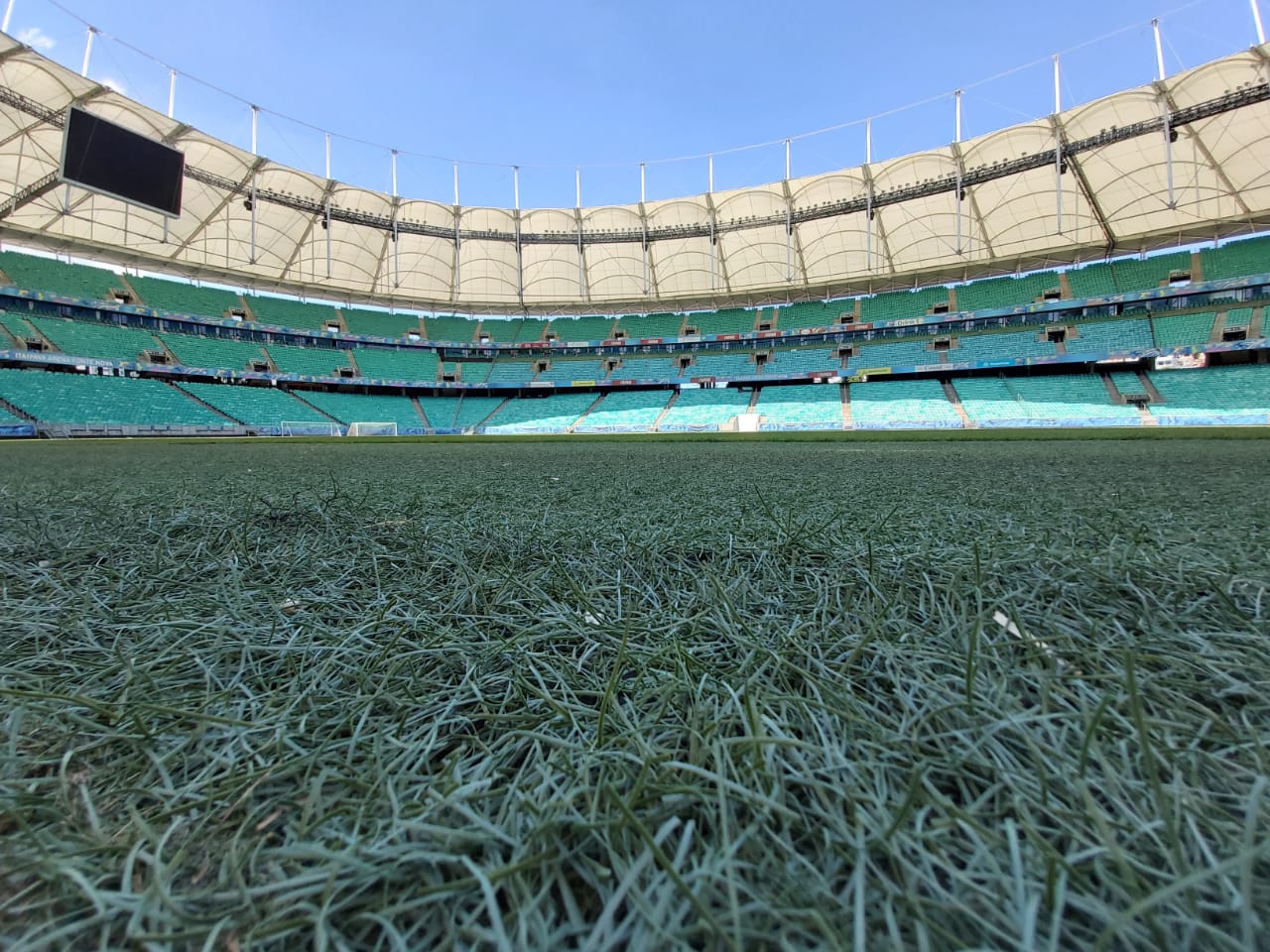
Photo: JonasBR, CC BY-SA 4.0, via Wikimedia Commons. The Arena Fonte Nova in Salvador is one of the eight host stadiums.
How to watch
Broadcasters are named here only where FIFA's own media-partners document or a FIFA announcement confirms them, and no per-match channel schedule is claimed, because none has been confirmed.In the United States, Netflix holds the exclusive rights for 2027 and 2031, showing all matches live in English and Spanish.In Spain, RTVE is the listed partner through the European Broadcasting Union, whose announcement says EBU members will show all matches live, with at least one match per day guaranteed on EBU member channels; which RTVE channel or platform carries each individual match is not confirmed here.In Brazil, Globo shows 56 games live on free-to-air TV Globo and all 64 on SporTV, while CazéTV shows all 64 live, streaming free on third-party digital platforms.
In Argentina, FIFA's media-partners document lists TyC International B.V. and DirecTV Latin America as partners, but which matches each carries is not confirmed.In Mexico, no named broadcaster was confirmed in this research — FIFA's document lists Mexico only under a rights company with no named Mexican channel — so this guide names no Mexican outlet for 2027 until a named source confirms one.That gap is stated plainly rather than filled with a guess, because a Spanish-language guide that names a Mexican channel without a source would be fabrication.For readers in the United Kingdom, no broadcaster is asserted as this page's headline claim without a separate re-check at build time.
Tickets: how to buy
Ticket sales for the 2027 Women's World Cup open on Tuesday, December 1, 2026, at 10:00 local time in Brazil (14:00 CET), FIFA announced on November 13, 2026. The first sales phase runs for eight days, through Tuesday, December 8, and it sells multi-match packages only — no single-match tickets in this phase. Every ticket is sold online, only at FIFA.com/tickets, on a first-come, first-served basis until the phase allocation runs out. FIFA advises fans to create a FIFA ID and register interest in advance, and to buy only from FIFA.com/tickets.
There are three packages in the first phase. The Brazil Team Pass guarantees access to all three of Brazil's group-stage matches, with prices starting at BRL 205 (USD 36) for category 3 seats. The Arena Pass covers every match at one chosen stadium, up to and including the quarter-finals where applicable, at a 27% saving compared with buying the same tickets individually. The Flex Pass lets the buyer choose any three eligible matches, and it can include one Brazil group-stage match or one semi-final; the final and the bronze final are excluded. Seats inside the packages start at BRL 30 (USD 5) per match in category 3, depending on the fixtures chosen, so a three-match package can cost under BRL 100 (USD 18). All advertised prices include tax, and every purchase is charged in Brazilian reais, so the dollar figure is a guide, not the amount charged.
The first phase closes before the final draw, which FIFA has confirmed for Friday, December 11, 2026, at the Museum of Modern Art in Rio de Janeiro. After the draw, when the match schedule including kick-off times is confirmed, a second sales window opens exclusively for Visa cardholders. Two further sales phases for all fans follow; FIFA has not yet given their dates. Accessible seating — wheelchair spaces, extra-wide seats and companion tickets — is available from the start of sales, as are half-price tickets for people entitled to them under Brazilian law.
| Package | What it covers | From |
|---|---|---|
| Brazil Team Pass | All three Brazil group-stage matches | BRL 205 (USD 36), category 3 |
| Arena Pass | All matches at one stadium, up to the quarter-finals | BRL 30 (USD 5) per match inside the package |
| Flex Pass | Any three eligible matches (one Brazil group match or one semi-final allowed; final and bronze final excluded) | BRL 30 (USD 5) per match inside the package |
Why Brazil 2027 matters
This is the first Women's World Cup in South America, and that is not a footnote.Brazil is the country of Marta, of six-time world player of the year honours, and of a women's league that has grown steadily even while the men's game dominated attention.Hosting the tournament puts the women's game at the centre of Brazilian football for a month, in stadiums built for the men's 2014 World Cup, with a host team that opens the tournament in front of its own crowd at the Maracanã.For Spain, the tournament is a defence of a first title won in 2023, with a generation of players who have since added European titles and club honours.For Argentina, qualification alone is a marker of progress: a direct place, confirmed well before the draw, rather than a play-off scramble.
And for the tournament as a whole, the second 32-team edition is the moment the expanded format stops being an experiment and becomes the standard.The 2023 edition in Australia and New Zealand showed the expanded field could work; Brazil 2027 is where it has to work on a continental scale, across eight cities and four weeks.
Quick answers
Is there a men's World Cup in 2027? No.The next men's edition is 2030, hosted mainly by Morocco, Portugal and Spain, with centenary matches in Uruguay, Argentina and Paraguay. How many teams play in 2027? Thirty-two teams, 64 matches. When is the final? July 25, 2027, at the Maracanã in Rio de Janeiro. When will the fixtures be known? After the final draw, reported for December 11, 2026, to be re-verified against FIFA. Who has qualified? Eighteen teams as of October 10, 2026, including Spain as defending champions and Argentina; Mexico, the United States and Canada were not yet qualified at that date, pending the Concacaf W Championship. When do tickets go on sale? Tuesday, December 1, 2026, at 10:00 local time in Brazil, for eight days through December 8, with multi-match packages only, sold first-come, first-served at FIFA.com/tickets. How much do tickets cost? Seats inside the packages start at BRL 30 (USD 5) per match in category 3; the Brazil Team Pass starts at BRL 205 (USD 36). Where can I read this in Spanish?
In the Spanish guide on this site: Mundial Femenino 2027: sedes y fechas.
Sources
Tournament facts in this guide are checked against FIFA's official announcements:
- FIFA — Player-first approach at the heart of the FIFA Women's World Cup 2027 match schedule — confirms the dates (24 June to 25 July 2027), 32 teams, 64 matches and the eight host cities.
- FIFA — FIFA Women's World Cup Brazil 2027 ticket sales to kick off on Tuesday, 1 December — confirms the sales window (1–8 December 2026), the three packages (Brazil Team Pass, Arena Pass, Flex Pass), the starting prices (BRL 30 per match; Brazil Team Pass from BRL 205), sales only at FIFA.com/tickets, and the final draw on Friday, 11 December 2026.
More football guides in English
See the English home for more guides, and the agenda for today's matches and official channels.