
MLS Standings
By the Fútbol Libre editorial team · Last updated: November 8, 2026
Quick answer: MLS standings explained: how the Eastern and Western Conference tables work, points, tiebreakers, playoffs and where to check the table.

Photo: Wdyork2, CC BY-SA 4.0, via Wikimedia Commons. Source: https://commons.wikimedia.org/wiki/File:AUFC_MLS_Cup_ceremony.jpg — Atlanta United lift the trophy at the 2018 MLS Cup final ceremony. The standings decide who gets to play for this trophy.
MLS standings are the league tables for Major League Soccer, the top professional soccer league in the United States and Canada. This guide explains how the tables work: the Eastern Conference standings, the Western Conference standings, the overall table, the points system, the tiebreakers, and how the standings decide the MLS Cup Playoffs.
There is no single MLS table that tells the whole story. MLS ranks its 30 clubs inside two conferences of 15, and the position that matters most for a club is its place inside its own conference. The overall table across all 30 clubs matters too, because it decides the Supporters' Shield for the best regular-season record.
What "MLS standings" means
When someone searches for "mls standings", they usually want one of three things: the Eastern Conference table, the Western Conference table, or the overall table with all 30 clubs in one list. All three are the same competition seen from different angles, and all three are built from the same numbers: matches played, wins, draws, losses, goals scored, goals conceded, and points.
MLS has 30 clubs: 27 in the United States and 3 in Canada. The league is split into the Eastern Conference and the Western Conference, with 15 clubs in each. Every club plays 34 matches in the regular season, 17 at home and 17 away. Clubs play conference opponents twice, once at home and once away, which is 28 games, and six different cross-conference opponents to make up the 34.
The regular season runs from late February to early November. In 2026, the 31st season of the league, the regular season runs from February 21 to November 7, with a break from May 25 to July 16 for the 2026 FIFA World Cup. The season ends on Decision Day, when every club plays its final regular-season game at the same time and the playoff places are locked in.
The standings are a live record, not a prediction. They show where every club stands at the moment you look at them, and they change after every final whistle. A table checked on a Saturday night can look very different from the same table checked on a Sunday night, especially late in the season when several clubs are fighting for the last playoff places.
How the MLS table works: points, wins and goal difference
MLS uses the standard points system used across world football. A club earns three points for a win, one point for a draw, and no points for a loss. A club's points total is the first and most important number in the standings: clubs are ranked inside their conference by points, highest first.
Goal difference is goals scored minus goals conceded. A club that has scored 55 goals and conceded 40 has a goal difference of +15. Goal difference matters in two ways: it is the second tiebreaker when clubs finish level on points, and it is a quick way to judge how dominant a club has been. A club on 50 points with a goal difference of +20 has usually been more convincing than a club on 50 points with a goal difference of +2, even though the points are equal.
Points per game, usually written as PPG, is sometimes shown alongside the table: points divided by matches played. It helps when clubs have played a different number of games, because a club with games in hand can sit below a rival on total points while being ahead on average. In a normal season total points decide the order; MLS uses points per game officially only if a conference cannot complete its full 34-match schedule.
There is no relegation in MLS. It is a closed league: the club at the bottom of a conference is not relegated to a lower division, and no club is promoted into MLS from below on sporting merit. The bottom of the table still matters, because it decides draft position and pride, but no club loses its place in the league for finishing last.
MLS standings tiebreakers, in order
When two or more clubs finish the regular season level on points, MLS uses a fixed list of tiebreakers, applied in order. The first tiebreaker that separates the clubs decides the order; the later ones are only reached if the earlier ones cannot separate them.
The official 2026 order, published in the MLS competition guidelines, is: first, total number of wins; second, goal difference; third, goals scored; fourth, head-to-head results between the tied clubs, but only for clubs in the same conference; fifth, fewest disciplinary points; sixth, away goal difference; seventh, away goals scored; eighth, home goal difference; ninth, home goals scored; and tenth, a coin toss if two clubs are tied, or drawing of lots if three or more clubs are tied.
The first tiebreaker surprises many fans. Wins come before goal difference in MLS, which is different from most leagues in Europe, where goal difference is usually the first tiebreaker. That means a club with 15 wins and a poor goal difference finishes above a club with 14 wins and a much better goal difference when both have the same points. Draws are worth a point, but they do not help in a tiebreak: a club that draws often and wins rarely is punished by this rule.
Head-to-head is fourth on the list, and it only applies between clubs in the same conference. That matters because the standings are decided inside each conference, so a head-to-head record against a club from the other conference never decides a place in the table. If two clubs are still tied after the head-to-head step, the process moves to disciplinary points, which count yellow and red cards across the season, and then to the home and away goal splits.
After a winner is decided by the tiebreaker, any clubs that remain tied go through the tiebreaker list again from the top to decide the next place. The process repeats until every place in the final standings is settled. In practice, the first three steps — wins, goal difference, goals scored — settle almost every tie, and the coin toss at the end is very rarely needed.
A worked example makes the order clear. Imagine two clubs both finish on 48 points. Club A has 15 wins and a goal difference of minus 5; Club B has 14 wins and a goal difference of plus 8. Club A finishes above Club B, because 15 wins beats 14 wins at the first tiebreaker, before goal difference is considered. These are teaching examples, not real clubs or predictions about any real season.
Eastern Conference standings
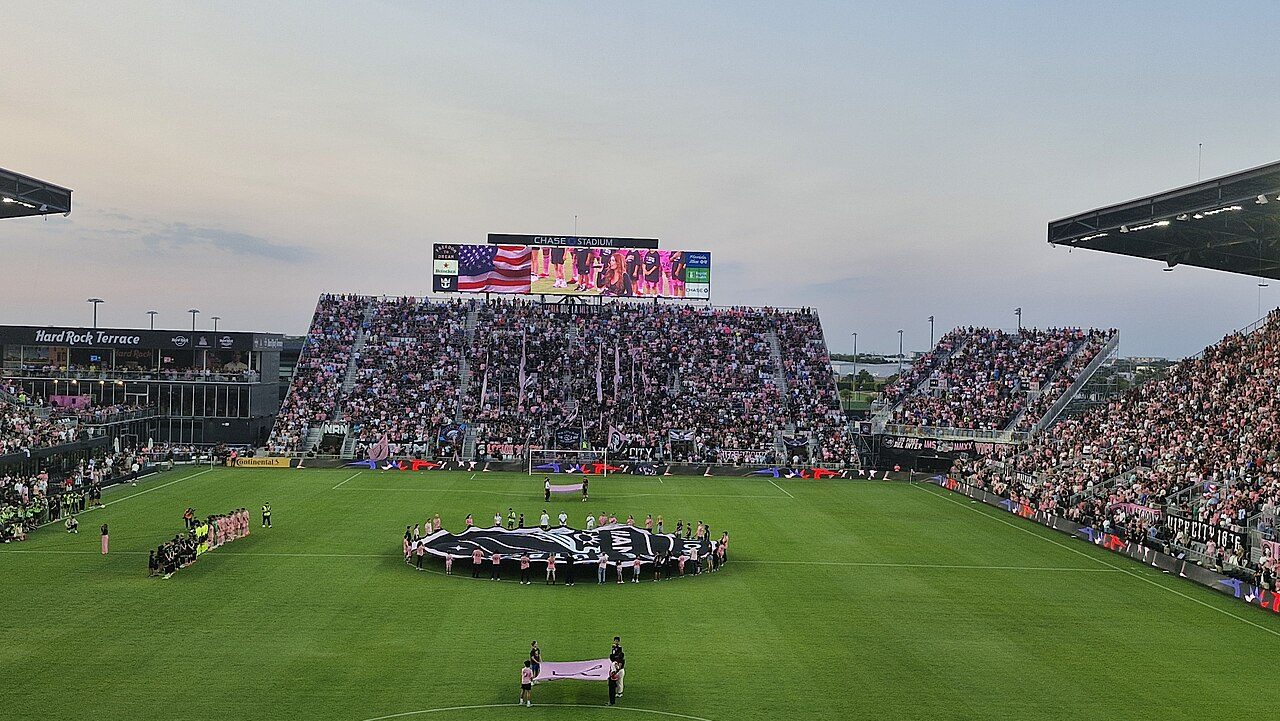
Photo: Erik Cleves Kristensen, CC BY 2.0, via Wikimedia Commons. Source: https://commons.wikimedia.org/wiki/File:Chase_Stadium_-_Inter_Miami_vs_Nashville_SC_(53671011121).jpg — Inter Miami against Nashville SC at Chase Stadium, an Eastern Conference fixture.
The Eastern Conference standings list the 15 Eastern clubs in order, from first to fifteenth. The clubs in the East include Atlanta United, Charlotte FC, Chicago Fire, FC Cincinnati, Columbus Crew, D.C. United, Inter Miami, CF Montréal, Nashville SC, New England Revolution, New York City FC, New York Red Bulls, Orlando City, Philadelphia Union and Toronto FC.
The top seven clubs in the Eastern Conference at the end of the regular season qualify directly for Round One of the MLS Cup Playoffs. The clubs in eighth and ninth place qualify for a single-elimination Wild Card match, with the winner taking the last Round One place. The clubs from tenth downwards are out of the playoffs, and their season ends on Decision Day.
When you read the Eastern standings, pay attention to the games-played column. Early in the season, clubs can be several games apart because of scheduling, and a club in eighth place with two games in hand may really be stronger than a club in fifth place that has played more games. By Decision Day, every club has played 34 games, and the table needs no adjustment.
Western Conference standings
The Western Conference standings list the 15 Western clubs in order, from first to fifteenth. The clubs in the West include Austin FC, Colorado Rapids, FC Dallas, Houston Dynamo, LA Galaxy, Los Angeles FC, Minnesota United, Portland Timbers, Real Salt Lake, San Diego FC, San Jose Earthquakes, Seattle Sounders, Sporting Kansas City, St. Louis City SC and Vancouver Whitecaps.
The same playoff rules apply in the West: the top seven qualify directly for Round One, eighth and ninth meet in the Wild Card match, and tenth downwards are eliminated. The West has its own race every season, and it is often the tighter of the two conferences, because the travel distances are longer and the home advantage in places like Seattle, Portland and Salt Lake City is famously strong.
San Diego FC is the newest club in the Western Conference. It joined MLS in 2025 as the 30th club, playing at Snapdragon Stadium, and its arrival completed the 15-and-15 split between the conferences. The 2026 season is the first in more than 20 years with no new expansion club added or planned, after a run of nearly one new club a year since 2005.
The Western table is also where the three Canadian clubs are split: Vancouver Whitecaps play in the West, while CF Montréal and Toronto FC play in the East.
How to read MLS standings today
Reading a live MLS table is a skill, and it is mostly about knowing which numbers matter and which ones mislead. Start with points, then matches played, then goal difference. Those three columns tell you almost everything: how many points a club has, whether it has played more or fewer games than its rivals, and how convincingly it has earned those points.
Next, look at the form column if the table shows one, usually the last five results as W, D and L. Form tells you the direction of travel: a club in sixth place that has won four of its last five is a different prospect from a club in sixth place that has lost four of its last five, even though their points are the same today. Form is not part of the official ranking, but it is the best guide to where the table is heading.
Then look at the qualification marks next to the clubs. Most standings pages mark the playoff places, the Wild Card places and the eliminated clubs with letters or colours. The usual marks are: a club that has clinched a playoff place, a club that has clinched the Supporters' Shield, and a club that is eliminated from playoff contention. These marks update as results come in, and they are more useful than the raw position, because they tell you what is still possible.
Finally, check the date and time on the table. A standings page is only as good as its last update, and a table that has not been refreshed since the weekend's games is worse than useless during a busy matchday. The official MLS standings page and the major scores services update within minutes of a final whistle. If the table you are looking at still shows last week's games played, find a fresher one.
MLS playoff standings: who qualifies

Photo: YoTuT, CC BY 2.0, via Wikimedia Commons. Source: https://commons.wikimedia.org/wiki/File:LA_Galaxy_vs_Houston_Dynamo-_Western_Conference_Finals_panorama.jpg — A packed stadium for the LA Galaxy against Houston Dynamo in a Western Conference Final, the kind of game the standings decide.
Nine clubs from each conference qualify for the MLS Cup Playoffs, eighteen in total. Seeds 1 to 7 in each conference go straight to Round One. Seeds 8 and 9 in each conference play a single-elimination Wild Card match, hosted by the eighth seed, and the winner takes the last Round One place against the first seed.
Round One is a best-of-three series. The higher seed hosts the first and third games, the lower seed hosts the second, and any game level after 90 minutes is decided by a penalty shootout, because there are no draws in the playoffs. The first club to two wins advances. The conference semifinals and conference finals are single matches hosted by the higher seed, and MLS Cup, the final, is hosted by the finalist with the better regular-season record.
That hosting rule is why the overall table matters even after the conference tables have decided the playoff field. A club that wins its conference final does not automatically host MLS Cup: the final goes to the finalist with the better regular-season record, so a Supporters' Shield winner that reaches the final hosts it, but a lower seed that upsets its way through must travel.
The playoff line is the most watched part of the standings from August onwards. The gap between seventh and eighth is the difference between a direct place in Round One and a one-off Wild Card game where a whole season can end in 90 minutes. The gap between ninth and tenth is the difference between the playoffs and the end of the season. Both gaps are often decided by a single point on Decision Day.
The 2026 playoffs run from November 18 to December 18, with MLS Cup on December 18, 2026. The Wild Card matches open the postseason, and the tournament then runs through Round One, the conference semifinals and the conference finals to the single-match final.
Supporters' Shield and the overall table
The overall MLS table puts all 30 clubs in one list, ranked by points regardless of conference. The club at the top of that table at the end of the regular season wins the Supporters' Shield, the trophy for the best regular-season record in the league. The Shield is a separate honour from MLS Cup: the Shield rewards the best team over 34 games, while MLS Cup rewards the winner of the playoff tournament.
The Supporters' Shield began as a fan-created trophy. After the first MLS season in 1996, supporters wanted a trophy for the best regular-season record, as in most leagues around the world, and the Shield was first awarded in 1999, with the 1996 and 1997 winners recognised retroactively. It is now an established part of the league, and the Shield winner also earns a place in the Concacaf Champions Cup and home advantage through the playoffs.
The LA Galaxy hold the most MLS Cups, with six, and share the record for the most Supporters' Shields, with four, level with D.C. United. The league's all-time single-season points record was set in 2024 by Inter Miami, with 74 points. Those records are history, not current standings: this page carries no live table, so check the official standings for the current season's numbers.
MLS Next standings and MLS Next Pro standings
Searches for "mls next standings" and "mls next pro standings" are common, but they are not the first-team MLS table, and mixing them up is the easiest mistake in this topic. MLS Next and MLS Next Pro are separate competitions in the development pathway below the first team, and each has its own standings.
MLS Next Pro is the professional development league for MLS clubs, where reserve and academy players get competitive minutes. Its clubs are mostly the second teams of MLS clubs, and its standings follow the same points system as the first team, but they have nothing to do with the MLS Cup Playoffs. A club can top the MLS Next Pro table while its first team sits at the bottom of the MLS standings, or the other way round.
MLS Next is the youth academy league, for age-group teams from MLS academies and other elite youth clubs across the United States and Canada. Its standings are split by age group, so there is no single MLS Next table. If you are looking for a first-team table and you land on an MLS Next or MLS Next Pro page, you are in the wrong place: go back to the Eastern or Western Conference standings for the team you follow.
What does MLS stand for?
MLS stands for Major League Soccer. It is the top professional soccer league in the United States and Canada, and the name is used for the league itself, for its clubs, and for its competitions, including MLS Cup and the MLS Cup Playoffs.
The league was founded on December 17, 1993, as part of the United States' successful bid to host the 1994 FIFA World Cup: FIFA required the host country to establish a top-level professional league. The first season was played in 1996 with ten clubs, and the first match was held on April 6, 1996, when the San Jose Clash beat D.C. United in front of 31,000 fans at Spartan Stadium in San Jose. D.C. United won the first MLS Cup later that year.
From ten clubs in 1996, the league grew steadily, reaching 30 clubs with the arrival of San Diego FC in 2025. The 2026 season is the league's 31st season, and the league now stretches from Vancouver and Seattle in the north-west to Miami in the south-east, and from Toronto and Montréal in Canada to San Diego on the Mexican border.
Where to check MLS standings and watch MLS
The official MLS standings are published on mlssoccer.com, the league's official site, and that is the table to trust when two sources disagree. The major scores services also carry the tables and update them within minutes of a final whistle, and they are useful for checking the table alongside live scores and results.
For watching MLS in the United States in 2026, every match is available on Apple TV, included in a standard Apple TV subscription with no local blackouts. The standalone MLS Season Pass subscription used from 2023 to 2025 was discontinued for the 2026 season, and all MLS content was folded into the Apple TV service. FOX and FS1 also carry selected matches — 34 regular-season games in 2026, 15 on FOX and 19 on FS1 — with Spanish-language coverage on Fox Deportes. In Canada, Apple TV carries every match, with TSN showing selected matches in English and RDS showing selected matches in French.
Two warnings apply to every standings and broadcast claim on this page. First, broadcast arrangements change from season to season: the Apple TV arrangement described here is the 2026 position, and it should be checked again for 2027. Second, never trust a site that promises free MLS streams: the official broadcasters above are the only legal way to watch.
For the rest of the site's English guides, see our MLS guide for the USA, which explains the league for new fans, our league standings guide, and our football fixtures today page for the day's matches.
MLS standings 2025 and 2026: reading year tables
Searches for "mls standings 2025" and "mls standings 2026" are the same question asked about different seasons, and the answer is to check the year on the table before reading it. The 2025 season is complete, so its table is final: the positions, the Shield winner and the playoff field will never change. The 2026 season is the current one, so its table is live and changes after every game.
When you search for a year table, check three things: the season year in the page title, the number of matches played, and the date of the last update. A table that says 34 matches played for every club is a final table; a table that says 25 matches played is a table from mid-season. A table with no date at all should not be trusted for the current season.
Common mistakes when reading the MLS table
The first mistake is reading the overall table as if it decided the playoffs. It does not. The playoffs are decided inside each conference, so a club in eighth place overall can miss the playoffs while a club in twelfth place overall qualifies, if the twelfth club is in the weaker conference. Always check the conference position first.
The second mistake is ignoring the games-played column. A club on 40 points from 28 games is ahead of a club on 41 points from 31 games, because the first club has three games in hand and needs only two points from them to pass the second. Until every club has played the same number of games, total points alone do not tell you the order.
The third mistake is assuming goal difference is the first tiebreaker. In MLS it is wins, then goal difference. A club with more wins finishes above a club with the same points and a better goal difference, and fans who apply the European rule get the order wrong every season.
The fourth mistake is confusing the first-team table with MLS Next Pro or MLS Next. Those are development competitions with their own tables, and they have no bearing on the MLS Cup Playoffs. If the table you are reading lists reserve teams and academy sides, it is not the MLS standings.
MLS standings FAQs
How many points do you get for a win in MLS?
Three points for a win, one point for a draw, and no points for a loss. Clubs are ranked inside their conference by total points, highest first, over a 34-match regular season.
How are MLS standings decided when teams tie on points?
By a fixed tiebreaker list: first total wins, then goal difference, then goals scored, then head-to-head results between clubs in the same conference, then fewest disciplinary points, then away goal difference, away goals scored, home goal difference and home goals scored, and finally a coin toss for two clubs or drawing of lots for three or more.
How many teams make the MLS Cup Playoffs?
Eighteen: the top nine from each conference. Seeds 1 to 7 go straight to Round One, a best-of-three series, while seeds 8 and 9 play a single-elimination Wild Card match for the last Round One place.
What is the Supporters' Shield?
The trophy for the best regular-season record across all 30 MLS clubs, decided by the overall table. It is separate from MLS Cup, which is won by the playoff tournament, and the Shield winner also earns a Concacaf Champions Cup place and home advantage through the playoffs.
What does MLS stand for?
Major League Soccer, the top professional soccer league in the United States and Canada. The league was founded in 1993 and played its first season in 1996 with ten clubs.
Where can I watch MLS games in the US?
Every MLS match in 2026 is on Apple TV, included in a standard Apple TV subscription with no local blackouts; the separate MLS Season Pass ended after 2025. FOX and FS1 also show 34 selected regular-season matches, with Spanish coverage on Fox Deportes.
What is the difference between MLS standings and MLS Next Pro standings?
MLS standings are the first-team league tables that decide the MLS Cup Playoffs. MLS Next Pro standings are for the professional development league of reserve and academy teams, and MLS Next standings are for youth academy age groups; neither affects the first-team playoffs.