
FA Cup Fixtures
By the Fútbol Libre editorial team · Last updated: November 8, 2026
Quick answer: FA Cup fixtures 2026-27: every round, key dates, how the draw works, replays, and where to watch the FA Cup on TV in the UK.
FA Cup fixtures are the matches of the Football Association Challenge Cup, the oldest football competition in the world and the most famous cup in English football. This guide explains the FA Cup fixtures for the 2026-27 season: every round, the key dates, how the draw works, what happens when a tie is level, and where to watch the FA Cup on television in the UK.
The FA Cup is a knockout competition open to hundreds of clubs, from the Premier League down to the smallest clubs in the English football pyramid. A club that loses a tie is out. A club that wins keeps going. That simple rule is what makes the FA Cup special: on any given weekend, a club from the fifth tier can knock out a Premier League club, and those giant-killing results are the most famous stories in English football.
The 2026-27 FA Cup began in September 2026 with the qualifying rounds, and the first round proper was played on the weekend of 7-8 November 2026. The competition runs through the winter and spring, with the Premier League and Championship clubs entering in the third round in early January 2027, and the final at Wembley Stadium on 23 May 2027. This page carries no live fixture list, so check the official FA or BBC fixture pages for the exact kick-off times of the next round — times move for television, and this guide explains the structure rather than listing fixtures that will be out of date within days. Our football fixtures today page explains how to follow fixtures across all competitions.
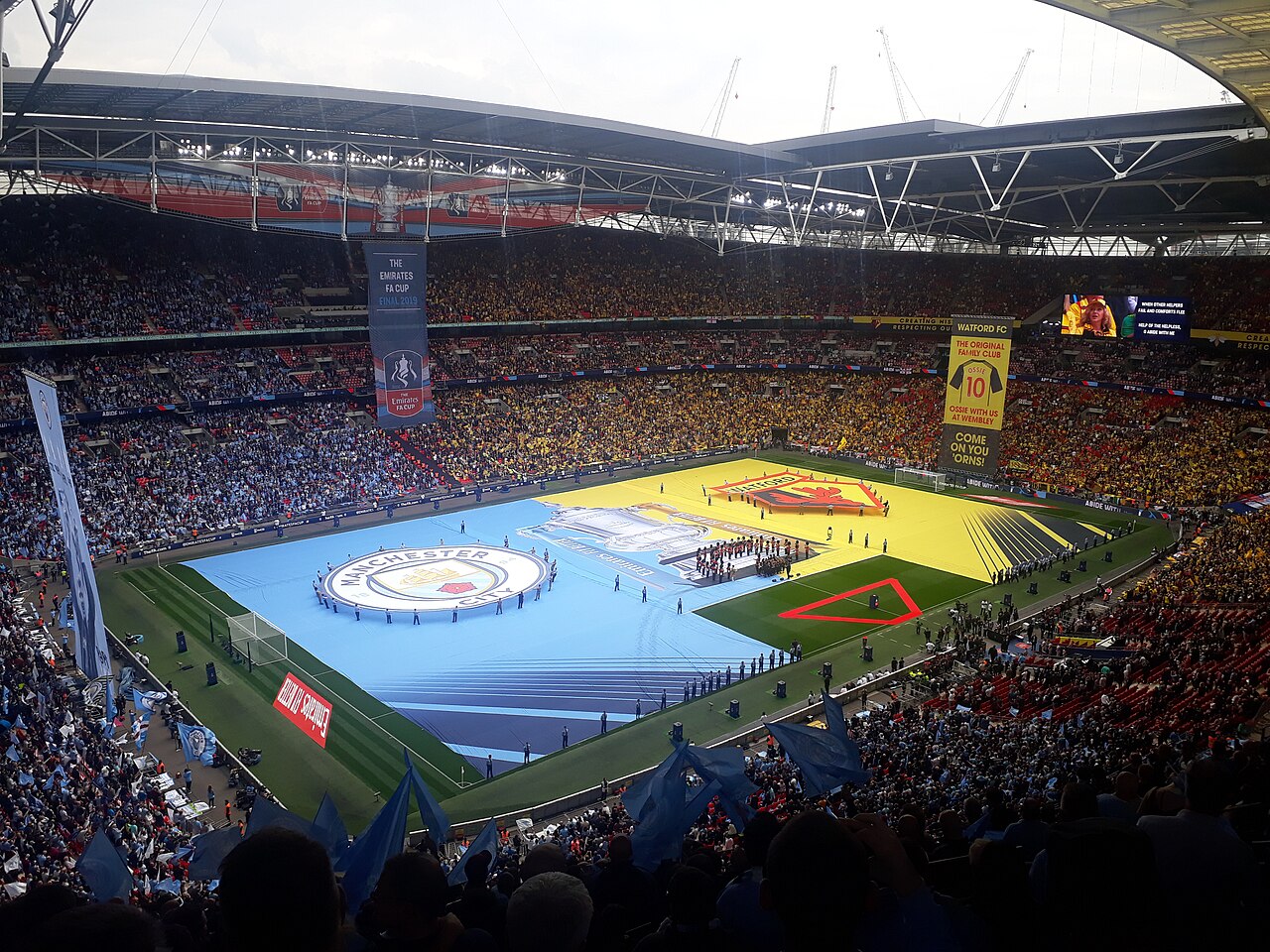
Photo: Oldelpaso, CC0, via Wikimedia Commons. Source: https://commons.wikimedia.org/wiki/File:2019_FA_Cup_final.jpg — The 2019 FA Cup final at Wembley — every FA Cup fixture in the season leads to this stadium.
What "FA Cup fixtures" means
When someone searches for "fa cup fixtures", they usually want the fixtures of the next round: who plays whom, when, and where. The most searched variations show the same need in different words: "fa cup fixtures today" for the matches being played today, "fa cup fixtures on tv" for the matches shown live, "bbc fa cup fixtures" for the fixtures on the BBC’s pages, and club-specific searches such as "arsenal fa cup fixtures" for one club’s cup ties.
An FA Cup fixture is different from a league fixture. A league fixture is one of 380 matches in a fixed schedule, and both clubs play again next week whatever happens. An FA Cup fixture is a knockout tie: the winner goes through to the next round, the loser is out of the competition for the season, and the draw for the next round is made before the current round is finished. The fixture list is therefore built round by round, and nobody knows the full list of fixtures in advance.
The draw is part of the event. Each round is drawn live, usually on television, with numbered balls pulled from a bag, and the clubs are paired home and away by chance. A Premier League club can be drawn away to a non-league club, and a tie between two small clubs can produce a winner that reaches the third round and a money-spinning tie against a big club. The randomness of the draw is the reason the FA Cup fixtures are followed so closely: the draw decides the stories.
Fixtures are also announced in stages for television. The FA and the broadcasters pick the matches they want to show live, and the kick-off times move around the weekend to fit them. A tie that starts as a Saturday 3pm kick-off can be moved to Friday night, Saturday evening or Sunday afternoon, so the fixture list should always be checked close to the day of the match.
FA Cup fixtures 2026-27: the rounds and key dates
The 2026-27 FA Cup started on 4 September 2026 with the qualifying rounds, where the smallest clubs in the competition begin. Hundreds of clubs from the lower levels of the pyramid play through the extra preliminary round, the preliminary round and four qualifying rounds to reach the first round proper, where the clubs from League One and League Two enter.
The first round proper was played on the weekend of 7-8 November 2026, with 80 clubs taking part: the 48 clubs from League One and League Two, plus the 32 winners of the fourth qualifying round. The second round follows on the weekend of 5-6 December 2026, with the 40 winners of the first round playing for twenty places in the third round.
The third round is the round most fans mean when they talk about FA Cup fixtures. It is played in early January 2027, on the weekend of 9-10 January, and it is when the 44 clubs from the Premier League and the Championship enter. The draw for the third round is one of the biggest dates in the English football calendar, because it pairs the biggest clubs in the country against the survivors of the early rounds, and it produces the giant-killing ties the competition is famous for.
After the third round, the competition moves quickly: the fourth round in late January, the fifth round in late February, the quarter-finals in March, the semi-finals at Wembley on the weekend of 24-25 April 2027, and the final at Wembley Stadium on 23 May 2027. The final is the last domestic match of the English season, and the winners qualify for the Europa League the following season.
How the FA Cup draw works
The draw is made after the previous round is played, and it is made in public, usually live on television. Each club left in the competition is given a number, the numbers are put into balls, and the balls are drawn in pairs: the first ball drawn is the home club, the second is the away club. There is no seeding in the FA Cup, so any club can be drawn against any other club, and the biggest clubs can be drawn against each other in the third round.
The draw for the early rounds is regionalised, which means clubs are drawn against clubs from the same part of the country to keep travel short for the smaller clubs. From the first round proper onwards, the draw is national, and a club from the south can be drawn away in the north. The draw for each round is made before the replays of the previous round are played, so a club can be drawn into the next round before it knows whether it has won its replay — a quirk that produces the famous "winners of tie number 14" announcements.
The order of the draw matters for television. The broadcasters pick the ties they want to show live after the draw is made, and the kick-off times are then moved to fit the television schedule. A tie that is picked for live television can be moved to Friday night, Saturday lunchtime, Saturday evening or Sunday afternoon, and the rest of the ties stay at the traditional Saturday 3pm kick-off.
For fans of small clubs, the draw is the most important night of the season. A home draw against a Premier League club can be worth hundreds of thousands of pounds in television money and ticket sales, and it can pay for a club’s ground improvements or keep it alive for another season. The FA Cup fixtures are followed so closely because the draw decides who gets that chance.
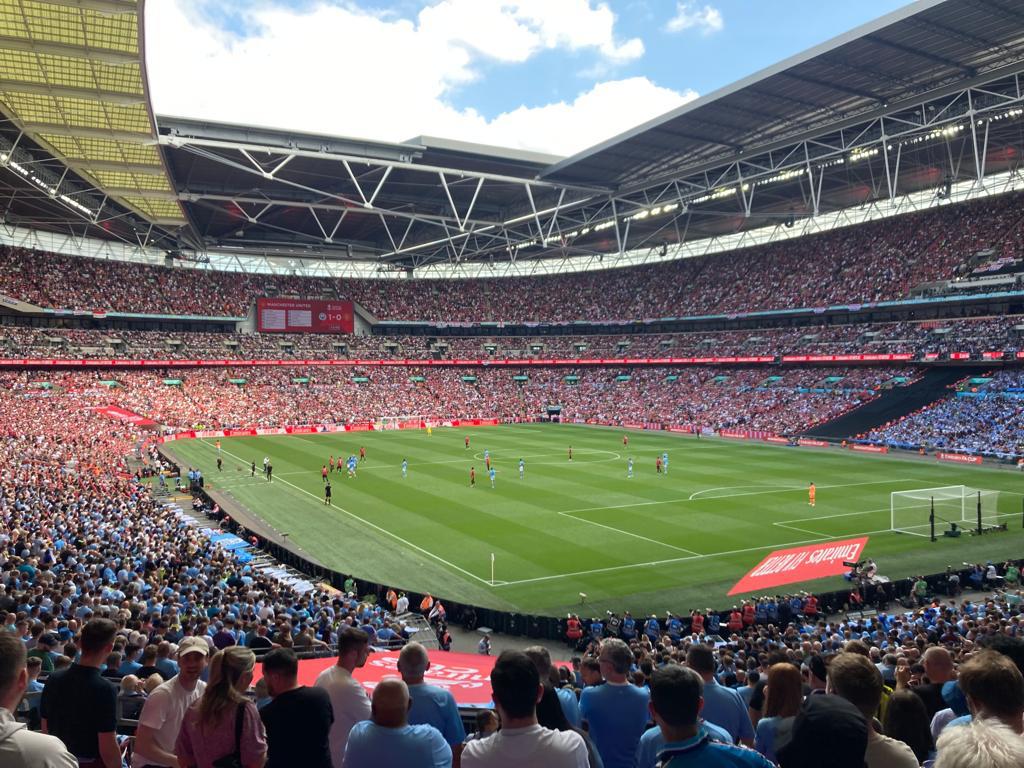
Photo: Ratchet8865, CC BY-SA 4.0, via Wikimedia Commons. Source: https://commons.wikimedia.org/wiki/File:City_vs_United_FA_Cup_final_2023.jpg — Manchester City against Manchester United in the 2023 FA Cup final — a derby final at Wembley.
What happens when an FA Cup tie is level
If an FA Cup tie is level after 90 minutes, it goes to extra time: two periods of fifteen minutes. If it is still level after extra time, it goes to a penalty shootout, and the winner of the shootout goes through to the next round. There are no replays in the FA Cup from the first round proper onwards: replays were removed starting with the 2024-25 season, so every tie in the main competition is now decided on the day.
The removal of replays changed the competition in two ways. First, it removed the famous replay nights, where a small club that had drawn away at a big club earned a money-spinning replay at home. Second, it made the fixture list cleaner, because there are no replay dates to fit into an already crowded calendar. The change was controversial with smaller clubs, who lost a source of income, and popular with the bigger clubs, who gained rest.
Extra time and penalties make the FA Cup different from league football, where a draw is a valid result. In the cup, somebody has to win, and the shootout is the cruellest way to decide it. A goalkeeper can become a hero by saving two penalties, and a striker can become a villain by missing one, and the whole season of a small club can end with a single kick.
One exception is worth knowing: in the qualifying rounds, replays still exist, because the smaller clubs play more matches and the calendar is less crowded. From the first round proper onwards, though, the rule is simple: ninety minutes, extra time if needed, penalties if still level, and the winner goes through.
FA Cup fixtures on TV in the UK
In the UK, the FA Cup is shown by TNT Sports and the BBC. TNT Sports is the main broadcaster, showing the majority of the live ties from the first round onwards, including the final. The BBC is the free-to-air partner, showing selected ties live on BBC One, BBC Two and BBC iPlayer, including the final, which is free to watch for everyone in the UK.
The BBC’s free coverage is the reason the FA Cup stays visible to everyone, not just subscribers. In the first round of the 2026-27 season, the BBC showed ties live on BBC Two and iPlayer, including non-league clubs playing at home against Football League opposition, and those are the matches that make the competition famous. The final is one of the events that must be shown free-to-air in the UK, so it is always on the BBC as well as on TNT Sports.
Kick-off times move for television, and the Saturday 3pm blackout applies to the FA Cup as it does to the league: no live football can be shown on UK television between 2.45pm and 5.15pm on a Saturday, so televised ties are moved to lunchtime, the evening or Sunday. Check the broadcaster’s listings close to the day of the match, because the television picks are announced in batches and the times change. Our football on TV today page explains how UK football listings work.
Outside the UK, the FA Cup is shown by the local rights holders in each country, and the FA’s own channels carry highlights and clips. If you are outside the UK and want to watch, check local listings rather than assuming the UK broadcasters are available where you are.
The giant-killings: why FA Cup fixtures matter
The FA Cup is famous for giant-killings: results where a club from the lower divisions beats a club from the Premier League or the Championship. The most famous recent example is the 2013 final, when Wigan Athletic, who were relegated from the Premier League in the same season, beat Manchester City 1-0 at Wembley. The most famous giant-killing of all is probably Hereford United beating Newcastle United in 1972, a result that is still replayed every year.
Giant-killings happen in the FA Cup more than in any other competition for three reasons. First, the big clubs often rest players in the early rounds, because the league and Europe matter more to them. Second, the small club is at home, on a pitch the big club is not used to, in front of a crowd that treats the match as the biggest day in the club’s history. Third, it is a one-off match: the small club only has to be better for ninety minutes, not over a season.
The fixtures that produce giant-killings are usually the third-round ties, when the Premier League clubs enter and are drawn away to lower-league clubs. The 2026-27 third round, in early January 2027, will produce the same stories: a non-league club at home to a Premier League club, a full house, a muddy pitch, and a result that nobody predicted. Those are the fixtures that make the FA Cup worth following even if you do not support any of the clubs involved.
For the clubs involved, a giant-killing can change a season. The prize money for winning a round is modest, but the television money, the ticket sales and the replay of the result for years afterwards are worth far more. A club that beats a Premier League club in the FA Cup is remembered for it forever, and that is why the fixtures matter so much to the smaller clubs.
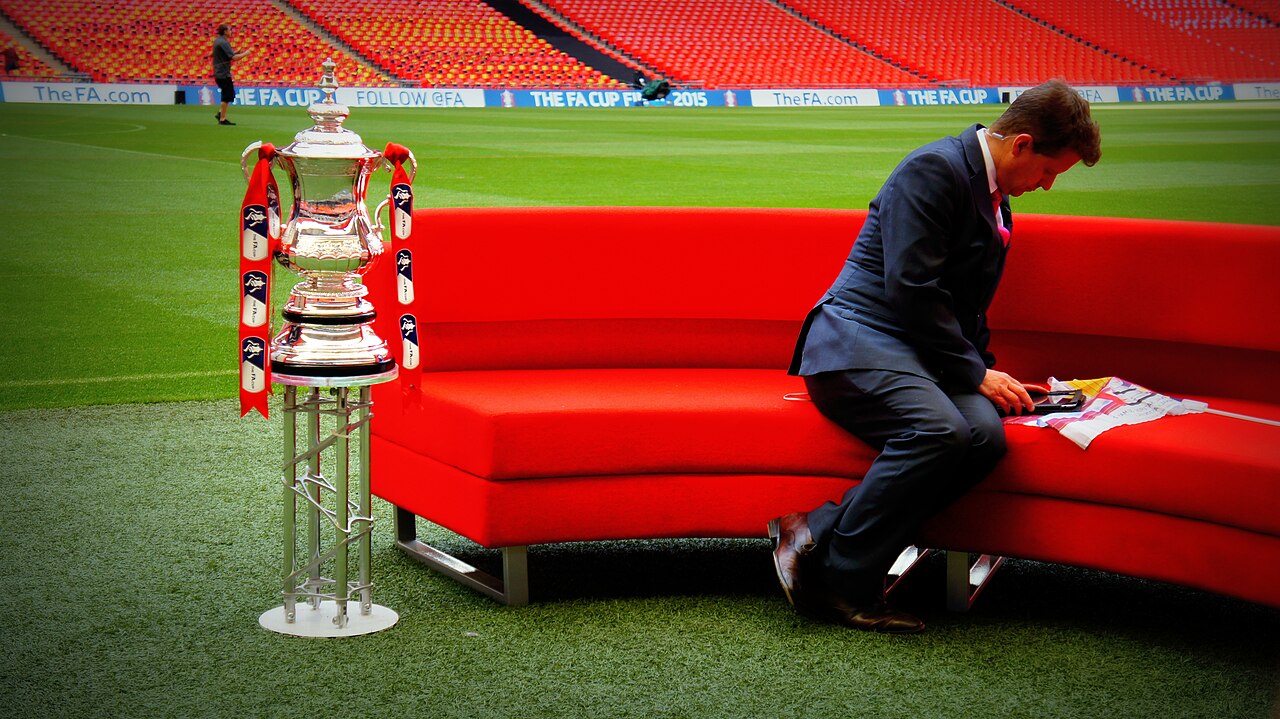
Photo: philosophyfootball, CC BY 2.0, via Wikimedia Commons. Source: https://commons.wikimedia.org/wiki/File:FA_Cup_Final_2015_(5).jpg — Arsenal lift the trophy after the 2015 FA Cup final — the most successful club in the competition’s history.
FA Cup history and records
The FA Cup was first played in the 1871-72 season, which makes it the oldest football competition in the world. The first final was played at the Kennington Oval in London in 1872, when Wanderers beat Royal Engineers 1-0 in front of about 2,000 spectators. The competition has been played every season since, except during the two world wars, and the final has been played at Wembley Stadium since the new stadium opened in 2007.
Arsenal are the most successful club in FA Cup history, with fourteen wins, and Arsène Wenger is the most successful manager, with seven wins. Manchester United have won the cup thirteen times, and the record for the most goals in a single FA Cup match is 26-0, when Preston North End beat Hyde in 1887. The fastest goal in an FA Cup final was scored by Louis Saha for Everton after 25 seconds in 2009.
The FA Cup has also been won by clubs from outside the top division. The most recent was Wigan Athletic in 2013, and before that West Ham United won it as a second-division club in 1980. No club from outside the top two divisions has ever won the cup, but several have reached the semi-finals, and the competition’s history is full of lower-league clubs reaching the later rounds.
The trophy itself is one of the most recognisable in world football. The current trophy is the fourth version of the cup, introduced in 2014, and it is a replica of the 1911 design. The winners keep the trophy for a year, and the ribbons on the trophy are in the colours of the winning club. The FA Cup final is the last match of the English domestic season, and it is watched by millions around the world.
Common mistakes when following FA Cup fixtures
The first mistake is assuming the fixtures are fixed. They are not: the draw is made round by round, the kick-off times move for television, and a tie can be postponed for weather or for a waterlogged pitch. Always check the fixture list close to the day of the match, and check the broadcaster’s listings for the kick-off time.
The second mistake is assuming replays still exist in the main competition. They do not: from the first round proper onwards, ties are decided on the day by extra time and penalties. Fans who remember the old replay nights sometimes expect a second match that is never going to happen.
The third mistake is confusing the FA Cup with the Carabao Cup, the League Cup. The FA Cup is run by the Football Association and is open to hundreds of clubs from all levels of the pyramid. The Carabao Cup is run by the English Football League and is open only to the 92 clubs of the Premier League and the Football League. They are different competitions with different fixtures, different draws and different finals.
The fourth mistake is assuming the big clubs always win. They do not, and that is the point of the competition. The FA Cup fixtures are worth following precisely because the result is not predictable, and the most memorable matches are the ones where the smaller club wins. If you only follow the fixtures of the big clubs, you miss the best part of the cup.
FA Cup fixtures FAQs
When are the FA Cup fixtures for the next round announced?
After the draw for that round, which is made live on television once the previous round is played. The kick-off times are then set by the broadcasters, so check the official FA or BBC fixture pages close to the day of the match.
When is the FA Cup third round in 2026-27?
Early January 2027, on the weekend of 9-10 January. That is when the 44 clubs from the Premier League and the Championship enter the competition.
When is the FA Cup final in 2027?
Saturday 23 May 2027, at Wembley Stadium in London. The final is the last domestic match of the English season.
Are there replays in the FA Cup?
Not from the first round proper onwards. Ties are decided on the day by extra time and then a penalty shootout. Replays were removed starting with the 2024-25 season.
Where can I watch the FA Cup in the UK?
TNT Sports shows the majority of live ties and the BBC shows selected ties free on BBC One, BBC Two and BBC iPlayer, including the final.
How does the FA Cup draw work?
Each club left in the competition is given a number, the numbers are drawn in pairs, and the first ball drawn is the home club. There is no seeding, so any club can be drawn against any other club.